Astrobiology · The Discovery Series

First contact may not be
a message, but a trace.

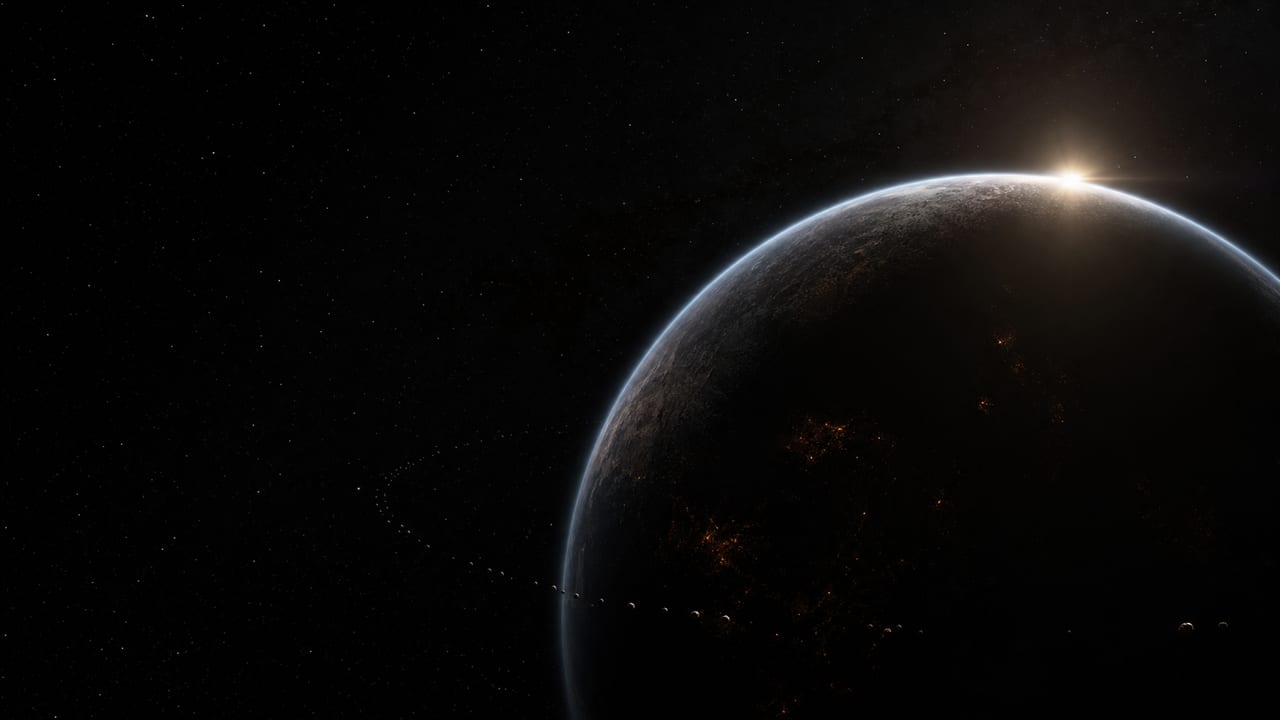
We have spent decades listening for a deliberate transmission. The first credible evidence of another technology may instead be chemistry, heat or structure: an unintended record written into a world.

Field  TechnosignaturesEra  NowSubject  The search beyond signalsBy  David W. Falls
Read at your altitude
The Glance — the essence in twenty seconds

For more than sixty years, the search for extraterrestrial intelligence has often been imagined as an act of listening: a radio pulse, a laser flash, a message meant to cross the dark. But technology changes environments whether or not it speaks. Industry alters an atmosphere. Machines release waste heat. Satellites and debris can arrange themselves into patterns nature rarely makes. The first credible sign of another civilisation may therefore arrive not as a greeting, but as a residue.

Artificial intelligence could help find such traces by ranking anomalies across data sets too large for people to inspect one object at a time. It would not prove that aliens exist. It would do something more modest and useful: identify the few observations that deserve a closer human look, while every natural explanation is tested first.

Why it matters

A search built only for deliberate messages may miss the longer-lived evidence that technologies leave behind. Looking for traces expands the question from “Is anyone calling us?” to “Has intelligence changed a world in a way we can measure?”

Same discovery · depth 1 of 3

This is the identical fact set, re-told at a different altitude. Switch any time — the reader keeps your place in the idea, not the prose.

Sources & further reading

5 primary sources · checked against the original papers
  1. P. X. Ma et al.A deep-learning search for technosignatures from 820 nearby starsNature Astronomy, 2023
  2. H. W. Lin, G. Gonzalez Abad & A. LoebDetecting industrial pollution in the atmospheres of Earth-like exoplanetsThe Astrophysical Journal Letters, 2014
  3. J. T. Wright et al.The G Infrared Search for Extraterrestrial Civilizations with Large Energy Supplies. III. The Reddest Extended Sources in WISEThe Astrophysical Journal Supplement Series, 2015
  4. J. T. Wright & D. KippingTechnosignatures in TransitThe Astronomical Journal, 2019
  5. H. Socas-NavarroImproved analysis of the detectability of artificial satellite constellations in exoplanetary transitsAstronomy & Astrophysics, 2020

Celestium retells peer-reviewed science for a general audience. Where a claim rests on a specific result, the primary work is cited above — read it at the source.