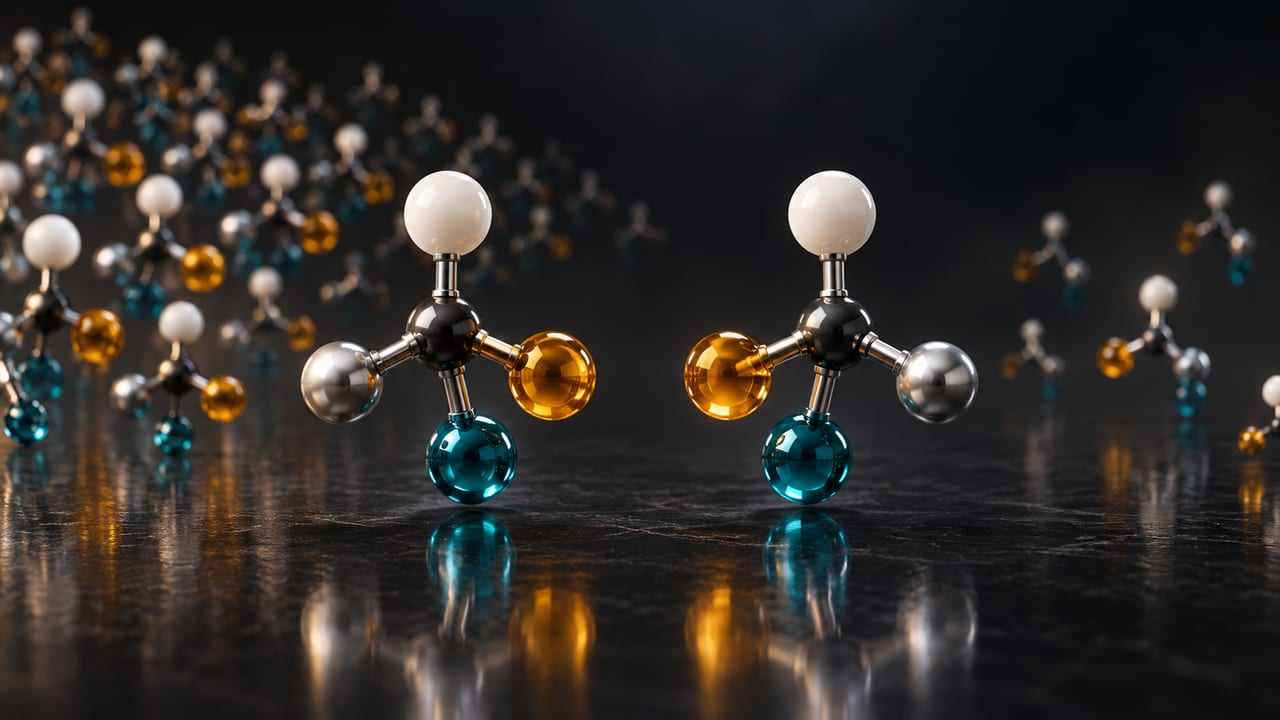
Your hands are mirror images, but a right glove will not fit a left hand. Some molecules have the same geometric distinction. Their atoms are connected in the same way; their arrangements cannot be made identical by rotation.
The 2026 Nobel Prize in Chemistry honours Henri B. Kagan and Kenso Soai for discoveries involving nonlinear effects and autocatalysis in asymmetric organic synthesis. Kagan showed that a catalyst's small imbalance need not be copied proportionally into its product. Soai demonstrated a reaction in which the product helps make more of itself while its handedness becomes more pronounced.
A small starting excess can be amplified by suitable chemical feedback. Equal starting populations remain equal in this deterministic teaching model; real molecular fluctuations are not simulated.
The people behind the discovery


Henri B. Kagan
Professor emeritus, former Université Paris-Sud
Born in France in 1930, Kagan earned his doctorate in 1960. His research in asymmetric synthesis showed that a catalyst's molecular imbalance need not pass proportionally into its product. The 1986 nonlinear-effects work made the behaviour of interacting catalyst species a question chemists could investigate experimentally.
Biography and contribution: source

Kenso Soai
Professor emeritus, Tokyo University of Science
Born in Hiroshima in 1950, Soai received his doctorate from the University of Tokyo in 1979. His group's experiments connected asymmetric autocatalysis with amplification of molecular handedness. A reaction product could help create more of itself while a very small initial excess became much more pronounced.
Biography and contribution: sourceA tiny initial preference can become a large chemical outcome. This supplies an experimentally demonstrated possibility, not a solved history of life's beginnings. The extraordinary achievement is making that distinction testable.
This is the identical fact set, re-told at a different altitude. Switch any time — the reader keeps your place in the idea, not the prose.