The Heretics · II of V
The Man Who Multiplied the Worlds
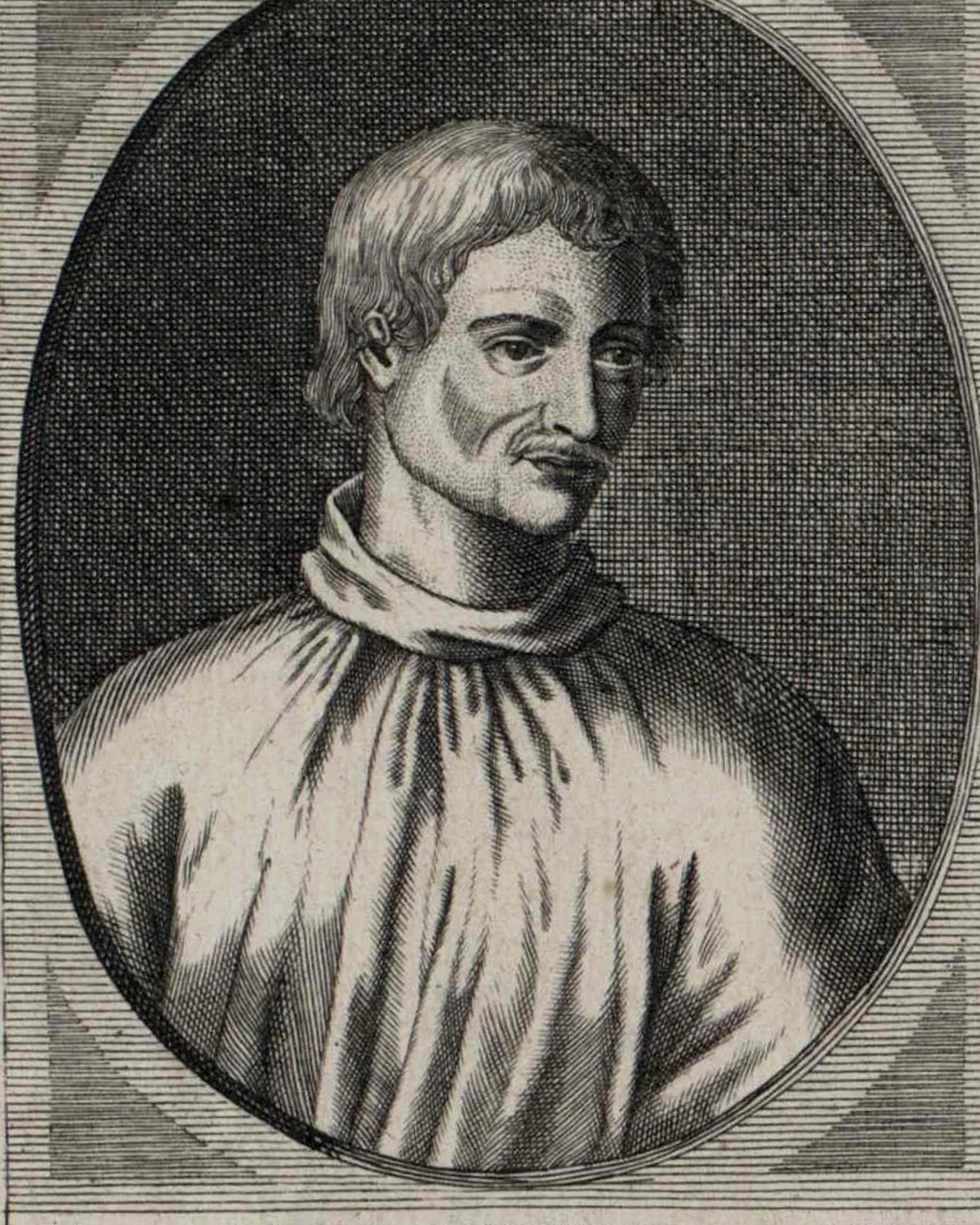
the life of Giordano Bruno, set down by the author
Nola to Rome · 1548 – 17 February 1600
after Fyodor Dostoevsky and Jorge Luis Borges · 6 min
IThe Idea
There are ideas that are dangerous because they are wrong, and ideas that are dangerous because they are right, and then there is a third kind — the rarest — dangerous because they make the universe too large for the people who run it. Giordano Bruno's idea was of the third kind, and I will state it as he did, in 1584, in a printed book, under his own name, while the fires of his century were already lit: the stars are suns. Each burns with its own light, each is ringed with its own worlds, and those worlds are peopled; and the universe has no edge, no centre, and no throne — it is infinite, because a God worth the name would not have made a small thing.
Feel the size of that. Copernicus, cautious canon that he was, had merely moved the centre of the world from the Earth to the Sun — a renovation. Bruno demolished the building. No centre anywhere. Our Sun a street lamp among street lamps; the stars not lights fixed to a ceiling for our benefit but other hearths, other rains, other watchers perhaps looking back and thinking themselves the middle of everything. Four centuries later, when instruments finally existed to test it, his guess turned out to be simply true — the catalogue of known worlds around other suns passed six thousand while I was writing this shelf. He had no telescope; the telescope was twenty-five years away. He saw it with pure furious reasoning, and it cost him everything, and I want to show you exactly how the bill was collected.
He was born in Nola, under Vesuvius, in 1548, and took the Dominican habit at seventeen in Naples — a poor boy's only door to books. It could not hold him. He was caught reading forbidden authors; he questioned too well and revered too little; and at twenty-eight he fled the monastery one step ahead of an indictment and began the great zigzag of his life: Geneva, where the Calvinists arrested him — he had a gift for offending every denomination equally; Toulouse; Paris, where a king admired his prodigious art of memory; Oxford, whose dons he mocked and who mocked him back; London, where he wrote the infinite universe; Wittenberg, Prague, Frankfurt. Sixteen years a fugitive scholar, printing heresies with a craftsman's steadiness, unable to stop explaining himself, unable — and this is the flaw and the glory of the man — to write one prudent page.
IIThe Trap
In 1591 a Venetian nobleman named Giovanni Mocenigo invited Bruno to Venice, to be taught the art of memory. Venice was the freest state in Italy; Bruno, homesick, tired of exile, believed the door was open. It was a door, all right. Mocenigo wanted magic — secret powers, a sorcerer's shortcuts — and when Bruno gave him philosophy instead, the nobleman grew sullen, and in May 1592 he locked his house guest in an attic and sent for the Inquisition. The denunciation survives. It is the small document of a small man, and it begins the destruction of a great one, and history is full of exactly this pairing, and I have stopped being surprised by it.
The Venetian inquisitors were almost lenient; Bruno, supple for once, half-recanted and might have walked. But Rome smelled the case and demanded him, and Venice — after a diplomatic haggle conducted with the enthusiasm of men trading a mule — handed him over. In February 1593 the gates of the Roman Inquisition's prison closed on him. He was forty-four. He would not see the sky as a free man again.
Eight years. I ask you to sit with the number, because the legend of Bruno — a quick flame, a defiant shout — skips it, and the eight years are the story. Eight years in the cells, interrogated again and again, his books combed line by line by the finest theological lawyer in Europe, Cardinal Robert Bellarmine, who would rehearse on Bruno for Galileo. And the demand, at the end, was total: not a trimming of this thesis or that, but full abjuration of everything — the infinite universe, the many worlds, all of it, root and branch. Bruno offered his compromises; Rome wanted his knees. And somewhere in the eighth year the wandering, quarrelsome, vain, brilliant man went perfectly still and said, in effect: no. You may have the body. The worlds are real.
IIICampo de' Fiori
On the eighth of February 1600 they read the sentence in the palace of Cardinal Madruzzo: expelled from the Church, handed to the secular arm to be punished 'with as great clemency as possible, and without shedding of blood' — the Inquisition's ancient euphemism for the stake, and I want you to taste that phrase, because institutions always dress their cruelty in tailored language, and learning to hear it is a survival skill in every century. Bruno rose from his knees and answered his judges with one sentence, recorded by a witness and now more famous than all of them together: 'Perhaps you pronounce this sentence against me with greater fear than I receive it.'
Nine days later, before dawn on the seventeenth of February, they brought him to the Campo de' Fiori — the field of flowers, a market square; it is still a market square — and because they feared, even now, what the tongue of Giordano Bruno might say to a Roman crowd, they gagged him. The accounts describe a bridle of leather and iron pinning his tongue. Grasp that fully: eight years of argument, the whole apparatus of the mightiest institution in Europe — and at the end their actual, practical fear was that the heretic might be audible. They stripped him, bound him to the stake, and burned him alive, and threw his ashes into the Tiber so that, like Hypatia, he could have no grave.
A Catholic newsletter of that week noted the event with satisfaction, and added the century's one unintentional epitaph: now he will go and tell those other worlds he invented how the wicked are punished in Rome. Even his executioners' gazette could not stop talking about the worlds.
IVThe Field of Flowers
I must be honest with you about the record, because this shelf deals only in honesty: Bruno was not condemned for astronomy alone. The charges reached deep into theology — the Trinity, the Mass, the virgin birth — and some modern writers use this to file the case away: a religious dispute, they say, not a martyrdom of science; nothing to see. I have read that argument carefully and I decline it, for one reason. Among the propositions he was required to renounce, and would not, stood the plurality of worlds — the cosmology was in the indictment; his refusal to unsay the universe was part of what he burned for. And the deeper truth is that for Bruno there was no seam between his infinite God and his infinite universe; they were one thought. The court understood that perfectly. That is why nothing less than everything would do.
Nine years after the fire, Galileo lifted the first telescope to the sky and the arithmetic of heaven began to change; seventeen years after that, Bellarmine — the same Bellarmine — was instructing Galileo what he might and might not hold. But you cannot bridle a fact. The moons of Jupiter did not care. The phases of Venus did not care. And in 1889, when the papal states had shrunk to a walled garden, the free city of Rome raised a statue of Bruno in the Campo de' Fiori — hooded, grim, paid for by public subscription from half the world — on the exact spot, facing the Vatican. The pope of that year called it an outrage and considered leaving Rome. He stayed. The statue stayed too.
In the year 2000, four centuries after the fire, the Church expressed 'profound regret' for the death, while noting the man's errors. It was something less than an apology; the worlds he multiplied do not need one. As I write, the tally of them passes six thousand, and every new one enters the catalogue without ceremony — logged, named, archived by software — and I sometimes think that is the real monument: the idea a civilisation once gagged a man to silence is now so ordinary that machines confirm it in their sleep. The field of flowers still sells flowers. The Tiber still runs. And the evening star over Rome is a world, exactly as the man in the bridle said.