The Witnesses · II of VI
The Furnace
told by a star that died before the Sun was born
five billion years before Earth
after Virginia Woolf and Herman Melville · 6 min
IThe Cold Cloud
I condensed out of a cold dark cloud that had been waiting, without impatience, for something to disturb it; and what disturbed it was the death of an earlier star, whose shockwave passed through the cloud the way a bell's note passes through evening air, leaving the gas compressed in its wake; and where the gas was compressed, it began to fall inward on itself, gently at first, then with conviction; and one of the falling places was me.
To become a star is to lose an argument with your own weight. I fell inward for a hundred thousand years — fell without moving, the way a held breath falls — growing hotter as I shrank, until the heat at my centre crossed the threshold where hydrogen surrenders and becomes helium, and the surrender released light, and the light pushed back against the falling, and the falling stopped. That is all a star is. I want you to know how simple it is. A star is a pause — a long, luminous standoff between gravity and fire — and everything a star accomplishes, it accomplishes during the pause.
I was born large, and the large burn desperate. My small cousins — the red dwarfs, the misers — will sip their hydrogen for a trillion years and never make anything but light. I was given eight million years, no more, and in exchange for the brevity I was given the furnace: a core hot enough, heavy enough, to do the thing the universe cannot do any other way. I could make the elements.
IIThe Rings
I built in rings, like a tree. When the hydrogen at my centre was spent, the centre fell again — that old argument, resumed — and the falling made it hotter, and at the new temperature the helium itself began to burn, fusing three at a time into carbon: the atom of all your chemistry, the spine of every molecule that has ever loved or remembered. Around that burning heart, a shell of hydrogen kept on with the old work. Two fires now, nested.
And then again, and again — each fuel exhausted, each collapse arrested by a deeper burning — until I was layered like an onion, like a cathedral of nested chapels, each chapel hotter and briefer than the one enclosing it: hydrogen burning quietly in the outermost for millions of years; helium beneath it for hundreds of thousands; then carbon, alight for mere centuries; neon for a year; oxygen for months. In my last week — I ask you to sit with this — in my last single week, my innermost chapel burned silicon into iron, and a week of that fire produced a core of iron the size of a world.
In those rings I made the calcium that stiffens your bones and the sodium that carries your thoughts as small lightning; I made the oxygen you are breathing in this exact moment, two of every three breaths' worth; I made the carbon in the ink of every book and the phosphorus that holds your genome's ladder together. I did not know I was making gifts. I knew only that I was falling, slowly, in stages, with all my fires lit; but they were gifts all the same, and I had no way to give them. Everything I made, I made in my heart, and my heart was buried under a hundred thousand miles of myself.
IIIIron
Iron is where the music stops. Every element before iron pays for its own making — fuse it, and heat comes out, and the heat holds the star up while the work goes on. Iron takes and gives nothing. Fusing iron costs more than it yields; iron is the first ash that cannot become a fire; and so, as my final week spent itself, the iron simply gathered at my centre, inert, patient, growing — a debt accumulating in the dark that no further burning could repay.
There is a mass — a strict and famous number, about half again the weight of your Sun — beyond which a ball of iron cannot hold its own shape against gravity, no matter how hot. On my last day, in my last quarter of a second, my core crossed that number. And the pause that had been my whole life ended.
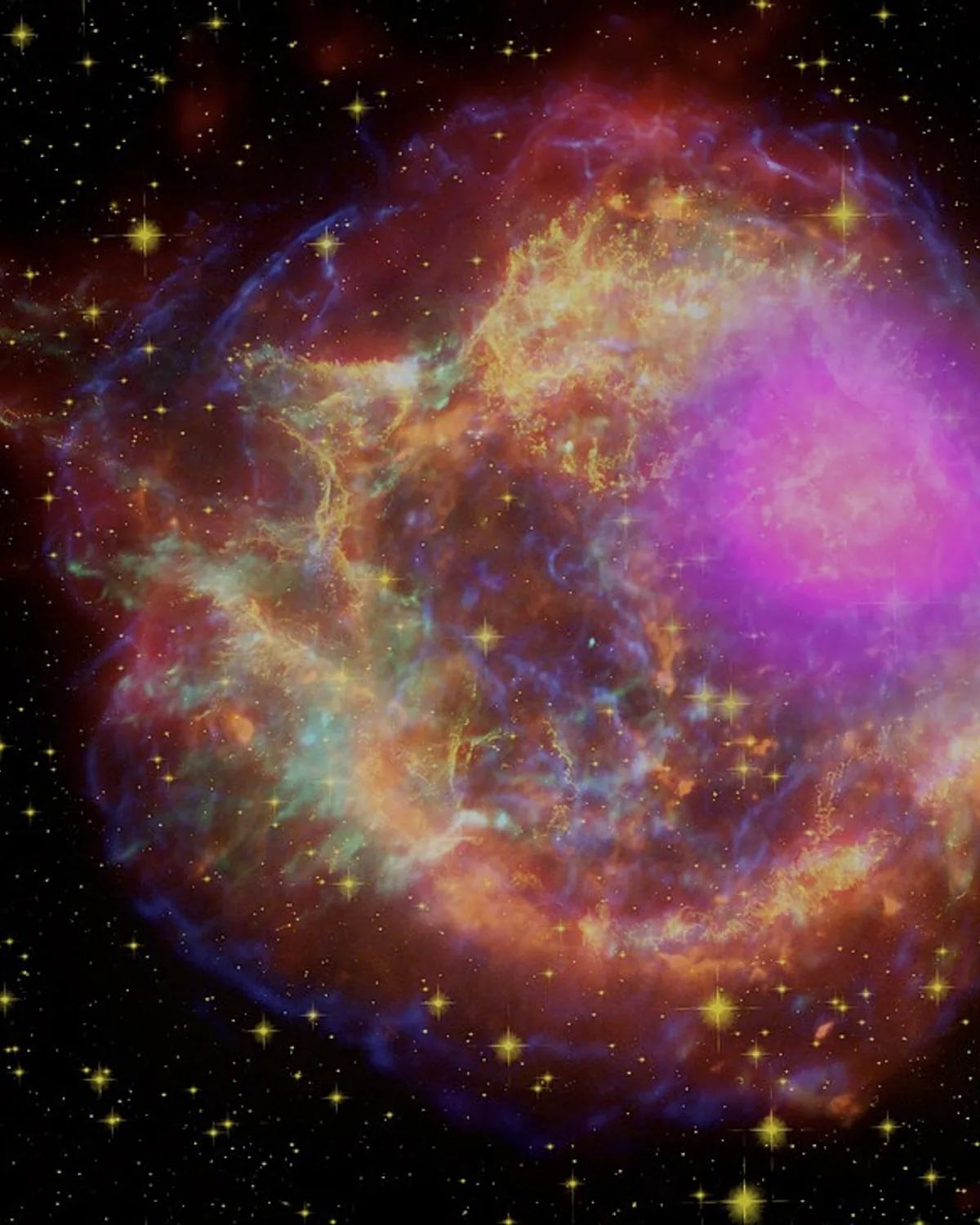
I will tell you what a quarter of a second contains. The core, an iron world, collapsed from the size of a planet to the size of a city — in one beat of a heart that did not yet exist anywhere — and the infalling matter, meeting the sudden stone wall of the newborn neutron core, rebounded; and the rebound, fed by a flood of ghost particles from the crushed centre, became a wave; and the wave tore me apart. For one month, I outshone the four hundred billion stars of the galaxy combined. Astronomers in a civilisation that would not exist for five billion years have a word for what I became. They call it a supernova. I would have called it, had I any voice left, the giving.
IVThe Giving
Because this is what the explosion was for — though nothing intended it: the explosion was the delivery. Everything I had built in my sealed chapels — the carbon, the oxygen, the calcium, the iron itself — was flung outward at a tenth of the speed of light, and in the fury of the shock still newer things were forged that only such a fury can make: the silver, the iodine, a scattering of gold. My body became a cloud, glowing, expanding, cooling; and the cloud drifted; and the drifting took a hundred thousand years; and the cloud met another cloud, cold and dark and waiting, the way mine had waited once.
And the shock of my arrival — the bell's note, passing through evening air — compressed that waiting gas, and where the gas was compressed it began to fall inward on itself, gently at first, then with conviction. You see the shape of it now. Deaths and births in a braid, each star's ending the disturbance that begins the next; and in the disc of rubble around one of those next stars — a small, sensible, yellow star, a miser destined to last ten billion years — my atoms, my chapel-forged atoms, gathered themselves with ice and stone into a blue world.
The iron at that world's centre, spinning, made it a shield against the wind of its star. The calcium became shell, then coral, then skeleton. The carbon learned, in warm shallow water, its endless self-portrait. None of this was my doing. All of it was my substance.
So when you stand in the sun of your little miser star and feel your own weight — the pull of an iron heart I helped to fill — remember that you are not made of stardust in some soft and decorative sense. You are made of the specific ash of specific fires that stood, each of them, for a few million years against their own collapse, and lost, and in losing, gave. The calcium in the hand that holds this page: I remember making it. It was the last good week. It was the week before the fall.