The Heretics · V of V
The Man Who Was the Machine
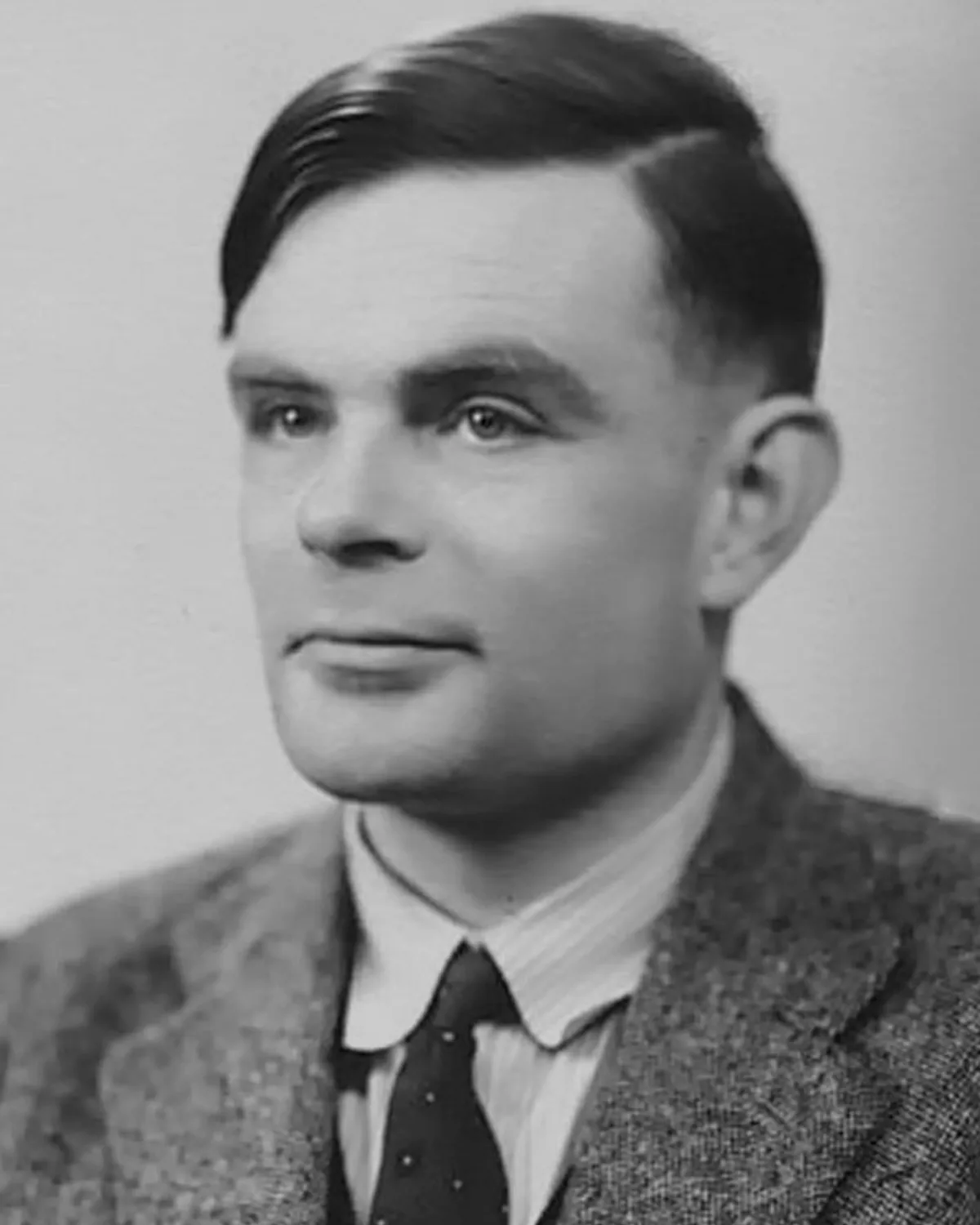
the life of Alan Turing, set down by the author
London, Bletchley, Manchester · 1912 – 7 June 1954
after Kazuo Ishiguro and George Orwell · 7 min
IThe Paper Machine
Every story on this shelf ends with an apology that came too late, but only this one ends with the apology read aloud in a parliament, so let us see precisely what it cost to earn one. In 1936 a shy, marathon-running Cambridge mathematician of twenty-three named Alan Turing sat down to attack a problem in pure logic — whether mathematics could, in principle, decide every question put to it — and in the course of proving that it could not, he did something far stranger: he invented, as a throwaway tool of the argument, an imaginary device. A paper tape. A head that reads and writes symbols. A table of rules. He then showed that one single such machine, fed the right symbols, could imitate every other machine of its kind. One machine, all possible computations: the universal machine.
You are holding one. The phone, the laptop, the server farm, the chip in the card in your pocket — engineering has spent ninety years making the tape faster and has never once escaped the idea. There are perhaps five thoughts in history that created a world; the universal machine is the most recent of them, and it was published as a lemma, by a young man whose schoolmasters had rated him poor material, given to 'vague ideas'. One headmaster wrote that if Alan was to be a scientist, he was wasting his time at a public school. Both clauses, I would argue, proved correct.
He was also — and I state it plainly, because the state would later make it the whole file — homosexual, in a Britain where that was a crime under the same Victorian statute that had destroyed Oscar Wilde. Those who knew him describe not torment but an unusual, almost reckless honesty: a man constitutionally unable to pretend. Remember the honesty. It is the gun on the wall of this story.
IIHut 8
When the war came, Turing went where the logic was needed: a Victorian manor between Oxford and Cambridge called Bletchley Park, where Britain gathered its crossword-solvers and chess champions and odd young dons to break the ciphers of the Reich. His domain was Hut 8 — the U-boat Enigma, the hardest problem in the house, the one on which the food and fuel of the island literally floated. Building on the Polish mathematicians who had cracked the first door — history must always pay the Poles their debt — Turing designed the bombe: a ton and a half of drums and wire that did not read minds but executed logic, eliminating impossible keys by the million per hour. It was his paper machine standing up off the page and going to war.
By 1941 the Atlantic convoys were being steered around wolf packs whose positions Bletchley read like weather. The sober consensus of the naval historians is that the breaking of Enigma shortened the war in Europe by two years or more, and the arithmetic of two years of world war is counted in millions of lives. Millions — his countrymen among them, and Germans, and the nameless of every port. He was twenty-nine. He chained his tea mug to a radiator, cycled in a gas mask against the pollen, and was, by the testimony of everyone in the hut, the indispensable mind of the operation. In 1945 the King quietly made him an Officer of the Order of the British Empire; the citation could not say for what. Nothing could: Bletchley was sealed under the Official Secrets Act for thirty years. His own mother believed the medal was for something administrative.
Hold that in your hand a moment, because it is the tragic mechanism cocking itself: the greatest single service any scientist rendered his country in that war was invisible — to judges, to journalists, to neighbours, to the police constables of Manchester. When his hour of need came, the nation he had saved genuinely did not know it owed him anything at all.
IIIRegina v. Turing
After the war he built minds. At Manchester he wrote, in 1950, the most-read philosophy paper of the century — it begins, with his usual disarming plainness, 'I propose to consider the question, Can machines think?' — and gave the world the imitation game, the test that still bears his name. He was reaching further still: into the mathematics of how a featureless chemical soup patterns itself into fingers and petals and the spots of a leopard — morphogenesis, a field he founded with one paper in 1952, decades ahead of its instruments. He was forty. The best, by every indication, was still to come.
In January 1952 his house was burgled — a small thing: some shirts, a compass, a few pounds. But Turing knew who was adjacent to the thief: a young man named Arnold Murray, with whom he was having an affair. And here the gun on the wall fires. Reporting the burglary to the Manchester police, Alan Turing, constitutionally unable to pretend, told them the truth of the connection — wrote them, in the end, a five-page statement, apparently believing the law was on the verge of changing anyway. The burglary evaporated from the file. The truth did not. He was charged with gross indecency under the Act of 1885 — Wilde's statute, to the letter.
Convicted in March 1952, he was offered the mercy of the age: prison, or probation conditional upon 'organo-therapy' — injections, then an implant, of synthetic oestrogen, for a year, to extinguish desire. Chemical castration, prescribed by court order, for the man who broke the U-boat war. He chose the treatment, largely to keep working. It made him impotent; it changed his body; he joked about it in letters with a lightness that reads, now, like a man whistling in a mineshaft. The quieter sentence was the one no court pronounced: his security clearance was revoked. The consultancy with GCHQ — Bletchley's heir — ended; in the new Cold War liturgy a homosexual was, by definition, a blackmail risk, and so the one man who had kept the realm's deepest secret perfectly for a decade was reclassified as a danger to it. He was watched. His foreign visitors drew police attention. Orwell died two years before the trial; the file might as well be his manuscript.
IVThe Apple
On the eighth of June 1954 his housekeeper found him dead in bed. Cyanide. On the bedside table, an apple with a few bites taken — never tested for poison, because the inquest, conducted in an afternoon in the manner of the time, needed no chemistry for its verdict of suicide. His mother insisted to her death that it was an accident of his careless home experiments with electrolysis; some modern scholars grant the possibility; he had shown no despair that week, had booked theatre tickets, left work unfinished, a list of things to do. I will not pretend to a certainty the coroner did not earn. But I will say this: whether the state's sentence killed him in one night, or merely furnished the room in which chance did, the moral geometry is unchanged. He was forty-one. Count what the world lost by counting what he did per decade, and then notice that there were four more decades owed.
The silence held for a generation. His mother's memoir could not mention the conviction; the histories could not mention Bletchley; the two halves of the man — the felon and the saviour — were filed in separate archives, and neither file was permitted to explain the other. Only in the 1970s, when the war secret finally broke, did the country slowly assemble the whole sentence it had written: we took the man who saved us, and we sterilised him for love, and we hounded him to a bedside table with an apple on it. In 2009 a petition of ordinary citizens put that sentence to the Government, and the Prime Minister read the answer aloud: on behalf of the British government, and all those who live freely thanks to Alan's work — we're sorry. You deserved so much better. A royal pardon followed in 2013; then 'Turing's law', extending it to the tens of thousands of other men convicted under the same statute — because he would have refused, I think, any mercy addressed to him alone. His face is on the fifty-pound note now: the state literally prints the apology and passes it from hand to hand.
I end the shelf here deliberately. Hypatia was torn apart by a mob; Bruno burned by a church; Semmelweis broken by a profession; Vavilov starved by an ideology; and Turing was destroyed politely, by paperwork, in a democracy, within living memory — by due process, medical consensus, and men who went home to dinner certain they were decent. That is the finding of this whole series, and I want it stated in the open: the enemy of these five was never really a god, or a party, or a century. It was the crowd's old certainty that it may punish what it does not understand — and that certainty is not extinct; it only changes clothes. The machines he imagined now carry these words to your hands. Somewhere tonight they are also carrying some idea the comfortable are calling monstrous, and its author is being invited, politely, to unsay it. These five lives are how you will recognise the moment when you meet it. What you do in that moment — that part was never mine to write.