The Heretics · I of V
The Geometer
the life of Hypatia of Alexandria, set down by the author
Alexandria · c. 355 – March 415
after Marguerite Yourcenar and Virginia Woolf · 6 min
IThe Last Librarian
I want to begin with her hands, because it is her hands the mob went for. Hands that had held the astrolabe steady while a student marked the altitude of a star; hands that had corrected, line by patient line, the great astronomy of Ptolemy — the edition she laboured on with her father is the one the world still used eleven centuries later, when Copernicus finally set it aside; hands that had drawn, in the sand of a lecture-hall floor, the cold and perfect curves of Apollonius — the ellipse, the parabola, the hyperbola — shapes that would one day turn out to be the true paths of the planets themselves. She was teaching orbits before anyone knew they were orbits. Hold that thought. Hold her hands in your mind. I will have to tell you what was done to them.
Hypatia was born in Alexandria around the year 355, the daughter of Theon, the last recorded member of the Museum — that thousand-year lighthouse of the mind where Euclid had written the Elements and Eratosthenes had measured the Earth with a stick and a shadow. Theon raised his daughter inside mathematics the way other fathers raised sons inside a trade, and she outgrew him, and he knew it, and — rare man — he was glad. By her forties she held the city's chair of philosophy. She lectured on Plato and on the geometry of the heavens to halls so full that men travelled from Cyrene and Syria to stand at the back. She wore the philosopher's plain cloak, a garment custom reserved for men, and walked the city in it, and no one dared laugh. She designed instruments — the plane astrolabe for reading the stars, the hydrometer for weighing liquids — and when one lovesick student pressed himself on her, the sources say she showed him the rags of her own menstrual blood: this, she said, is the body you love; there is nothing beautiful here; beauty lives in the theorems. I do not know a colder or a cleaner sentence in the ancient world.
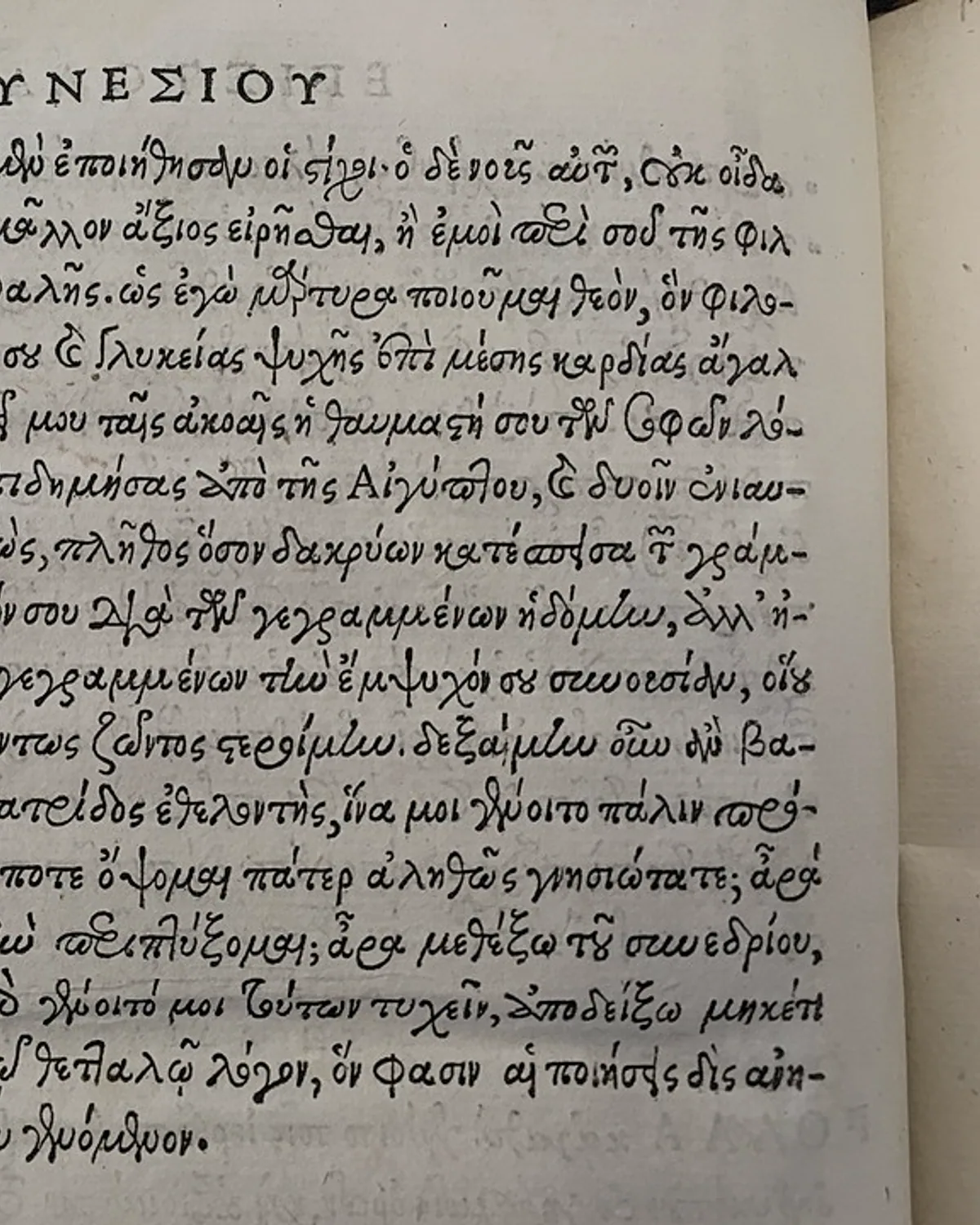
And here is the detail I ask you to keep. Her classroom held everyone: pagans, Jews, Christians, side by side, in a city tearing itself apart along exactly those seams. Her most devoted student, Synesius, became a Christian bishop, and his surviving letters to her begin, simply, 'To the Philosopher' — as though there were only one. He wrote to her about geometry and about his dying children. When the letters stop, it is because he is dead. He was spared, at least, what came next.
IIThe City
Now the city. Alexandria in 415 was three faiths and one knife-edge: the old pagans, their temples already rubble — the great Serapeum, a wing of the Library's soul, had been torn down by a Christian crowd in 391 while the philosophers watched and wept; the Jews, in the city since its founding; and the Christians, newly ascendant, led by a bishop named Cyril who understood, with the instinct of every ambitious man in every century, that a frightened crowd is a weapon that loads itself.
The Roman prefect, Orestes — a Christian himself, but a man of law — tried to hold the line of civic order against the bishop's swelling power. The two fell into open feud: riots, expulsions, a monk who struck the prefect with a stone and was tortured to death for it, and whom Cyril promptly declared a martyr. And in the middle stood Hypatia — friend and counsellor to Orestes, admired by half the council, owned by no faction: the one person in Alexandria whom everyone respected and no one commanded. So the whisper was started. You know the whisper; it has been used against knowing women for as long as there have been knowing women. She is why the prefect will not reconcile with the bishop. She has bewitched him. With her astronomy. With her instruments. With her mathematics — which, to a man who cannot do mathematics, has always looked like sorcery.
I want to be precise about the mechanism, because the mechanism is the lesson. Nobody burned a book of hers. Nobody refuted a theorem. That is not how it is done. You do not answer a mind like Hypatia's; you reclassify it. Philosopher becomes witch. Teacher becomes obstacle. Woman becomes thing. It took only a season.
IIIMarch, 415
It was Lent. She was driving home through the city she had served for sixty years, and a mob was waiting for her chariot. They were led — the sources agree — by a church reader named Peter; behind him the parabalani, the bishop's militia of hospital orderlies, men who carried the sick by day and did other work when asked. They dragged her from the chariot. They stripped her naked in the street — a woman of sixty, the finest mathematician alive — and hauled her into the church called the Caesareum, up to the very altar. And there, with ostraka — the word means oyster shells, or the sharp shards of roofing tile and broken pottery; scholarship still debates the material, and I confess the debate has always sickened me, as if it mattered — they flayed her. They scraped the skin from her while she lived. They tore her body into pieces, carried the pieces beyond the walls to a place called Cinaron, and burned them: no grave, no relic, no place for a student to stand and remember.
No one was punished. Read that sentence again, because it is the true ending of the story and I refuse to soften it: no one was ever punished. The imperial investigation was quietly starved and then quietly closed. Cyril's power grew. Centuries later his church declared him a saint and a Doctor of the Church, and he is venerated to this day; and when I first learned that — I was young, reading at night, the way perhaps you are reading now — I understood for the first time that history does not sort itself into justice on its own. It stays exactly as wicked as we leave it.
Her students scattered to Athens and the East, carrying what they could of her in their memories. Within two centuries the schools of Alexandria were embers. The commentaries she wrote survive, where they survive at all, as fragments folded anonymously into other men's editions — even her afterlife was made to wear a man's name. Of the woman herself we have not one written sentence that is certainly hers. The mob was thorough. Mobs are.
IVWhat Survives
And yet. I am writing her name, and you are reading it, sixteen centuries after Peter the Reader and his shells have rotted into namelessness. Every historian who tells this story tells it against Cyril — his sainthood carries a stain that will never scrub out, and the stain is shaped like her. The curves she taught became, in Kepler's hands, the actual architecture of the solar system; the astrolabe she was accused of sorcery for became the sextant, the observatory, the space telescope. There is a crater on the Moon named Hypatia, and there is nothing anywhere named for the man who led the mob — history, for once, kept the right name.
But I will not end on consolation, because consolation is a way of looking away, and this shelf exists to look. Hypatia was not a martyr who died for a doctrine; martyrs choose. She was a teacher, butchered in a church by men who had been taught that her existence insulted their certainty. The mathematics survived because mathematics is very hard to kill. The woman did not, because a woman is very easy to kill once the whisper has done its work. That asymmetry — the immortality of the theorem, the terrible softness of the hand that writes it — is the whole history of science in one sentence, and we will meet it again in every story on this shelf.
So when you next see the diagram of an ellipse — in a textbook, on a screen, in the flight plan of a probe falling perfectly around a far world — spare one second for the hands that drew it first, for students who loved her, in a bright room, in a doomed city, in the last generation when it was almost possible for a woman to be allowed to know things in peace.