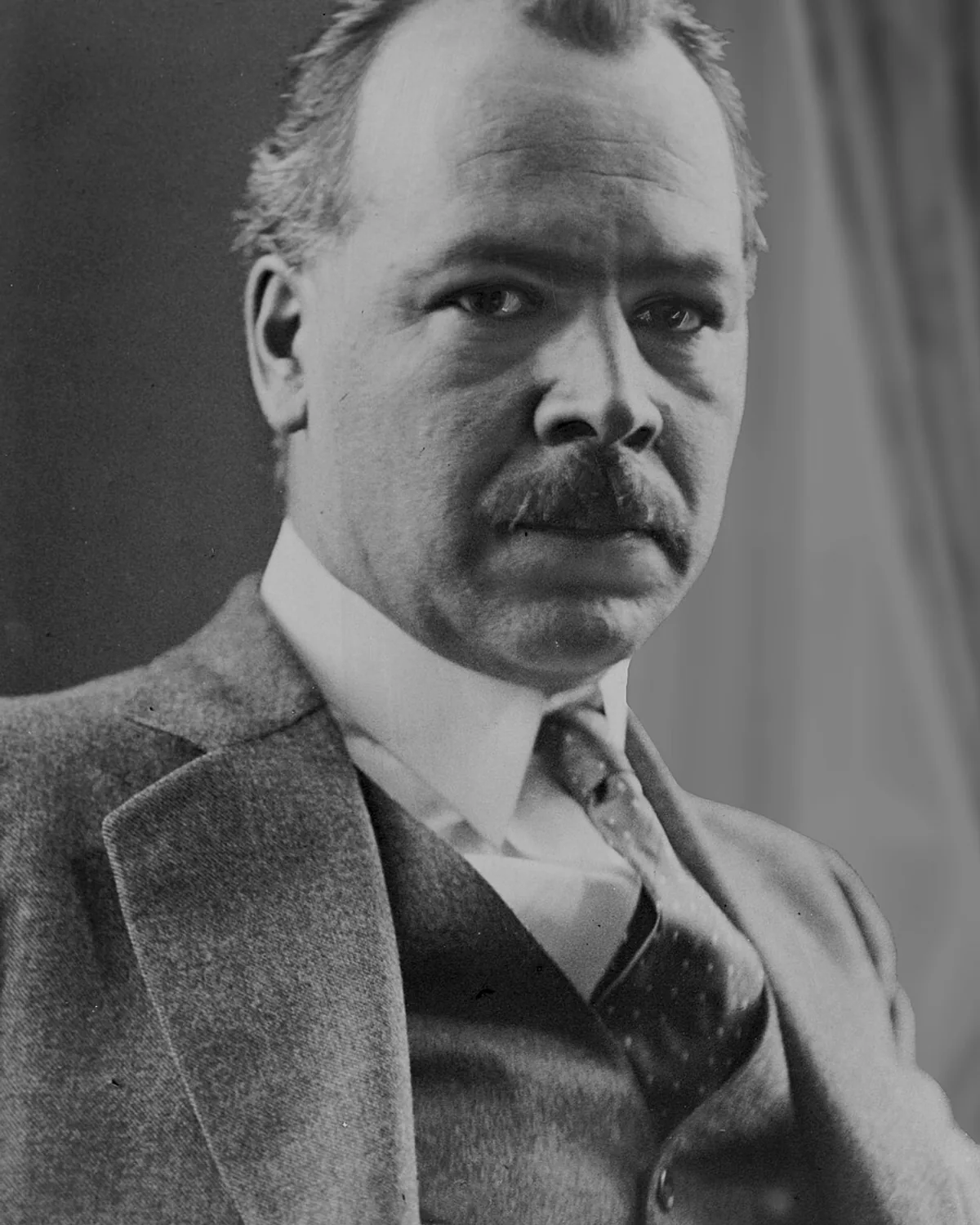
The Heretics · IV of V
The Man Who Fed the Future
the life of Nikolai Vavilov, set down by the author
Moscow, Leningrad, Saratov · 1887 – 26 January 1943
after Leo Tolstoy and Aleksandr Solzhenitsyn · 7 min
IThe Collector
Some men collect power and some collect gold, and once — once — there lived a man who collected the bread of the whole Earth. Nikolai Vavilov, a Moscow merchant's son born in 1887, grew up in a country where famine came the way winter came, on a schedule, and he made in his youth a vow of the kind only Russians make and mean: that in his lifetime, with science, he would end famine — not ease it, end it. I have read many mission statements. His is the only one I know that a man kept walking toward through five continents, a revolution, and finally a death cell.
His idea was simple and enormous. Every crop that feeds us is a domesticated wild thing, thinned by ten thousand years of farming into a narrow, pampered bloodline; but somewhere — in the mountain valleys where each crop was first tamed — its wild cousins still grow, carrying the old hard virtues: resistance to drought, to cold, to every rust and blight. Find those centres of origin, gather everything, and you hold the raw material to breed crops for any future whatsoever. So he went. Sixty-four countries, five continents, twenty years: Afghanistan by mule, over passes where his caravan was shot at; Ethiopia, where he charmed an emperor and gathered a thousand kinds of wheat; the Andes, the Sahara's edge, Kashgar, Japan. He slept four hours a night for decades, spoke a dozen languages badly and used all of them — 'life is short, we must hurry' — a big, laughing, unstoppable man beloved by his staff.
And what he built with the sacks he carried home was, quietly, one of the great structures of the twentieth century: in Leningrad, the largest collection of plant genetic material on Earth — a quarter of a million living samples. Not a museum. An ark. He said plainly what it was for: insurance for humanity, against catastrophes not yet imagined. By forty he was president of the Lenin Academy of Agricultural Sciences and the most famous scientist in the Soviet Union. And in 1925, at a provincial station, he was introduced to a sullen young agronomist of peasant stock, self-taught, with a gift for making plants seem to obey him and a deeper gift for making journalists believe it. Vavilov — generous to a fault, hungry for talent from below — praised him, promoted him, opened doors. The young man's name was Trofim Lysenko. Write it down. It is the name of the knife.
IIThe Lie
What Lysenko sold was hope with the arithmetic removed. Real plant breeding is slow — ten years, twelve, to stabilise a variety, as Vavilov honestly kept saying. Lysenko promised wheat transformed in a season: chill the seed and the improvement would pass to its children — heredity itself re-educated by environment, like a prisoner in a camp. It was nonsense; his experiments were unrepeatable, his statistics decorative, his rye-into-wheat a fairy tale. But look at what the lie offered Stalin's state: results now; deliverance from genetics — that bourgeois, foreign, priestly science of invisible genes; and a barefoot man of the people to deliver it, instead of a globe-trotting academician who corresponded with the West. In a country that had just starved millions through collectivisation, the fantasy was not merely attractive. It was policy, waiting for a face.
Through the 1930s the two men fought in the open, congress by congress, and it was never a fair fight, because Vavilov brought data and Lysenko brought the state. The expeditions were cancelled; the foreign travel stopped; the geneticists of his institute began to vanish into the night arrests, one by one, and every empty chair made the room quieter. Friends abroad begged him to defect — half the universities on Earth would have taken him. He refused every time, with the same argument: the collection. The ark could not emigrate. Someone had to stand between the seeds and the dark.
In 1939, at a conference where Lysenko's men bayed at him from the floor, Vavilov said the sentence for which I am telling you his life: 'We shall go to the pyre, we shall burn — but we shall not retreat from our convictions.' A man who had walked the whole Earth gathering bread told the twentieth century, to its face, that it could kill him sooner than make him lie about a chromosome. On the sixth of August 1940, while he was collecting wild grasses in the foothills of western Ukraine, a black car came up the mountain road. The men in it said Moscow required him urgently. His students watched the car take him. Eleven years of night had begun — his, and his science's.
IIICell Number Fifty-Seven
In the Lubyanka and then in Saratov prison they interrogated Nikolai Vavilov roughly four hundred times — seventeen hundred hours, sessions of ten and twelve hours through the night, the investigator fresh, the prisoner standing. The confession they finally wrung from him — sabotage, espionage for a ring that did not exist — he recanted at trial, for what a five-minute trial was worth. Sentence: death. He wrote to Beria offering the only currency he had — I can still be useful; I know how to grow food in a war — and death was commuted to twenty years, which in his case meant the same word said slowly. In the death cellar, without paper, he composed in his head a book on the history of world agriculture, and gave his cellmates — a dying scholar's reflex — a course of lectures on genetics. In the dark. To two other condemned men. Solzhenitsyn before Solzhenitsyn; I did not invent it and could not have.
And now the counterpoint, because history composed this one as a fugue. While Vavilov sat in Saratov, the Wehrmacht closed its ring around Leningrad, and inside the ring, in a cold building on Herzen Street, sat the ark — a quarter of a million samples, tons of it edible: rice, wheat, beans, potatoes. The city starved through the nine hundred days as no modern city has starved; people ate wallpaper paste, leather, worse. Vavilov's staff moved into the building to guard the collection — from rats, from shells, from the starving, from themselves — and set a rule of iron: the collection is the future's bread, and the future does not forgive. That winter and the next, at least nine of them died of hunger at their posts. The keeper of the rice was found dead at his desk, surrounded by his full bags of rice. The peanut curator died holding his catalogue. Not one sack was opened. I know of no cathedral, no shrine, no scripture that holds a fraction of the holiness of that unopened rice.
Their director — the man who had gathered every grain of it — died on the twenty-sixth of January 1943, in Saratov prison, of what the record calls dystrophy: the clinical word for starvation. The man who gave his existence to abolishing famine was starved to death by his own government, deliberately, over twenty-nine months, while volunteers defended his seeds with their lives. His family was told nothing. His brother Sergei, a physicist, was elected president of the Soviet Academy of Sciences while Nikolai lay in an unmarked prison grave; even the executioners could not decide whether they owned the name or feared it.
IVThe Harvest
Lysenko outlived him by decades, and this shelf does not deal in false comfort, so hear the full price. Lysenkoism ruled Soviet biology until 1964: genetics formally a heresy, its textbooks pulped, some three thousand biologists dismissed, imprisoned or shot. When Lysenko's doctrines were exported to Mao's China and folded into the Great Leap Forward, they helped deepen the greatest famine in human history — tens of millions dead. Set this beside Semmelweis's Vienna and see the same machine at continental scale: the lie flatters power, the truth insults it, and the crops do not care who won the vote. Wheat cannot be intimidated. That, in the end, is why the truth always comes back: reality is the one constituency that cannot be purged.
It came back for Vavilov the way dawn comes back in the north — slowly, then completely. Rehabilitated in 1955, two years after Stalin's death; the institute that never stopped guarding the ark renamed for him; his centres-of-origin theory now the load-bearing wall of crop science; his collection the mother of every seed bank on Earth, down to the vault sunk into the permafrost of Svalbard — which is his idea, wearing a Norwegian coat. When plant breeders today need a gene to save wheat from a new rust — and they do, every decade — they reach into collections descended from the sacks a tireless man carried down the mountains of Afghanistan on a mule. Every third loaf on Earth owes something to that mule train. I mean this as arithmetic, not poetry.
In Saratov there is a statue of him now, not far from the prison where they starved him, and bread is baked in that city every morning. That is the whole verdict, and I will not decorate it: they starved the man who fed them, and his answer — delivered posthumously, forever, in every language — is bread. We shall go to the pyre, we shall burn. But the harvest, gentlemen. The harvest is ours.