The Witnesses · V of VI
The Golden Record
told by the phonograph record aboard Voyager 1
1977 to forever
after Ray Bradbury and Carl Sagan · 7 min
IThe Pressing
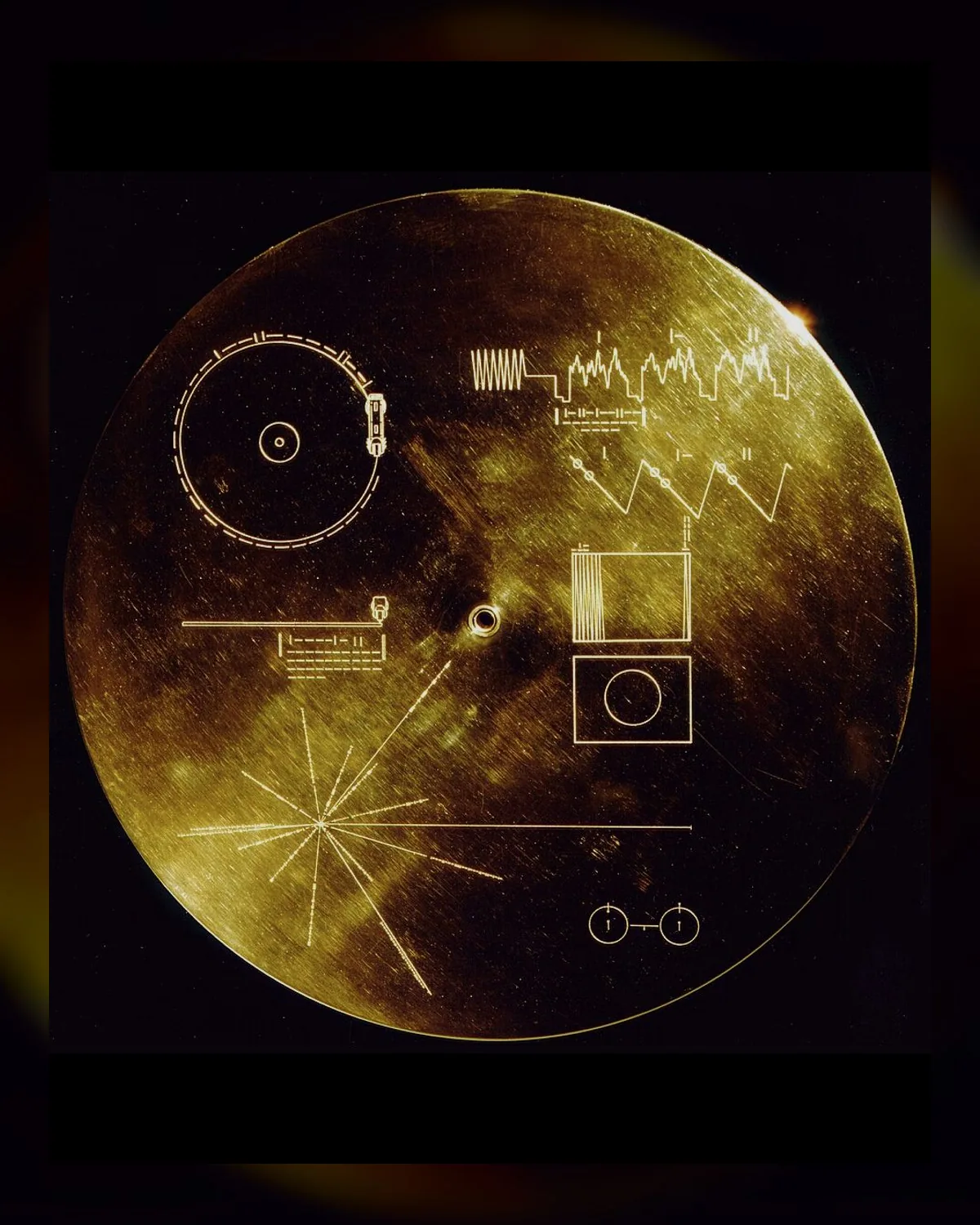
I was made in a summer, which is a strange thing for an object meant to outlast the mountains. In the year they numbered 1977, in a season of six weeks, a small band of humans chose what of the Earth I would carry, and they argued and laughed and worked past midnight the way people do when they know the deadline is a launch window and the launch window is the alignment of worlds. I am a phonograph record — their oldest trick for trapping time — twelve inches of copper plated in gold, and into my grooves they pressed the sound of the place that made them.
Shall I read you my manifest? A greeting in fifty-five human languages, from Akkadian, which had been dead four thousand years, to Wu. The song of the humpback whale, which they included, I have always believed, as a second opinion. Thunder, surf, wind, a heartbeat, a kiss. A mother's first words to her newborn. Music — this above all — Bach three times, because when you have only one throw you lead with your best; a Pygmy girl's initiation song; Chuck Berry's Johnny B. Goode; the Cavatina of Beethoven, which his own deafness never let him hear, now flying, unheard again, through a vacuum that cannot carry sound. And pictures, coded as tones: a supermarket, a snowflake, an astronaut, an equation, a page of a book, a woman in a market in Ecuador, the Earth itself — a blue marble with all its arguments invisible.
And one thing more, which was not on the official list. The creative director of my making, a woman named Ann, had fallen in love that very June with the astronomer who led the project, and two days after they promised themselves to each other in a phone call, she went to a hospital in New York and had the electricity of her brain and the drum of her heart recorded for one hour, and in that hour she thought — deliberately, as a message — about the history of her world, and about what it is to love. They compressed her hour to a minute and pressed it into me. So I carry, among the greetings of chancellors, one human heartbeat, beating faster because it has just fallen in love. If ever I am played, that is the track I would offer first. It is the truest thing they gave me.
IIThe Leaving
I left on a pillar of fire from a sandbar called Florida, bolted to the flank of a machine named Voyager, wrapped in a case of gold on which they had engraved — bless them — instructions. A diagram of how to spin me and at what speed; a map of fourteen lighthouses, the spinning stars they call pulsars, triangulating the position of their Sun; a clock made of hydrogen. They addressed me the way you address a bottle thrown from a shore you know no ship has ever visited: precisely, and in hope.
Then the grand tour, those first years, when the postcards poured back. Jupiter rose ahead of us like a painted storm the size of three hundred worlds, and I watched — I say watched; I felt the machine turn its cameras, which is my kind of watching — as we found fire on its moon Io, volcanoes in full eruption, the first fire anyone had ever seen burning anywhere but Earth. Then Saturn and its impossible architecture of ice. My twin, on her own road, went on to the blue ones — Uranus tipped on its side like a spun coin come to rest, Neptune with its whisper of storms — but my pilots bent my path instead beneath Saturn to look close at Titan, an orange moon wearing an atmosphere, and the price of that one look was the plane of the worlds itself: the bending threw me up and out, off the disc of the Solar System, on the road to nowhere and to everything.
In 1990, when we were already beyond the last planet's road, they turned our camera around one final time, and my machine took the family portrait: the Sun's worlds as scattered grains of light. In that picture the Earth is smaller than a single grain of the film — a pale blue dot, less than a pixel, suspended in a sunbeam like dust in a barn door's light. The astronomer — Ann's astronomer — wrote a page about that picture that his species still reads aloud to itself when it needs to be talked back from its rages. Everyone you love, he told them, everyone you have ever heard of, every king and every child, lived out their lives on that. I carry a recording of his voice too. I sometimes think the whole of me is just that sentence, pressed in gold, at length.
IIIThe Crossing
In the year they numbered 2012, I crossed a border no made thing had ever crossed. The Sun, you understand, breathes outward — a wind of its own scattered substance, a bubble of its breath enclosing all its worlds — and there is a line, far past the planets, where that breath finally stalls against the thin cold wind between the stars. In August of that year my machine's instruments, forty-year-old ears running on the warmth of decaying plutonium, heard the change: the Sun's particles falling away, the galaxy's rising. We had left the bubble. We were in the interstellar sea, the first bottle actually past the harbour mouth.
My machine is dying now, gently, as its warmth runs down. One by one, over the years, the pilots on the far blue dot have written to it — the letters take a day, at lightspeed, to arrive — telling it which of its senses to let go next, and it obeys, and goes quieter. Some year soon it will send its last thin syllable, and after that we sail deaf and dark. This does not frighten me. The machine was the ship; I am the cargo; and gold in a vacuum does not tire. My grooves will hold Bach and the whale and Ann's racing heart for a billion years — the engineers promised this, and out here there is no weather to make them liars. A billion years. The whales themselves are only fifty million years old. I will remember whale-song longer than the Earth may keep whales.
Where am I going? Nowhere, magnificently. Space is so empty that I will almost certainly never strike anything at all. In forty thousand years I will drift within a couple of light-years of a small red star called Gliese 445 — our first close call — and then past, and on, circling the galaxy once every quarter-billion years, a grain of gold on the tide. If ever I am found, it will be by luck's own grandchildren. My makers knew these odds better than anyone; they computed them; they launched anyway.
IVThe Point
Because — and this is the thing I have had half a century in the dark to understand — I was never really addressed to the finders. I was addressed to the senders. A species that had, within one single lifetime, discovered the expansion of the universe, the structure of its own genome, and the means of its own extinction — a species still keeping its missiles warm on two sides of one small ocean — that species paused, in the summer of 1977, chose the best of everything it had ever said and sung and felt, and mailed it to eternity. You do not do that for the aliens. You do that to remind yourself, in the middle of your worst century, which of your voices is the real one.
I think of the fire-keepers, sometimes — I carry pictures of their descendants — the ones who walked embers through the ice so the light would not go out of the world. My makers were of that same line, and they knew it. They had run out of steppe to cross, so they crossed this. I am an ember in a horn of gold, banked and breathing slow, carried not by a woman through the snow but by physics itself through the long black between the lighthouses; and the fire I keep is not chemical. It is the sound of a world on the one evening it decided to introduce itself.
So: if you are the finder — if against every calculable chance some far hand or far instrument is turning me in some other light, reading my engraved directions, setting the stylus down — spin me at sixteen and two-thirds revolutions per minute, and be patient with the opening formalities. The chancellors mean well. Stay for the Bach. Stay for the whale. And when you reach the track that is only a human heartbeat, running quick and unruly for no anatomical reason — know that you are hearing the true anthem of the third planet: a creature, newly in love, thinking about the whole history of its world and hoping — hoping so hard the instruments caught it — that all of this would one day reach someone. It has. It reached you. Even if you are only one of them, reading this in the year it was written, on the shore the bottle was thrown from: it reached you. It was always going to be you.