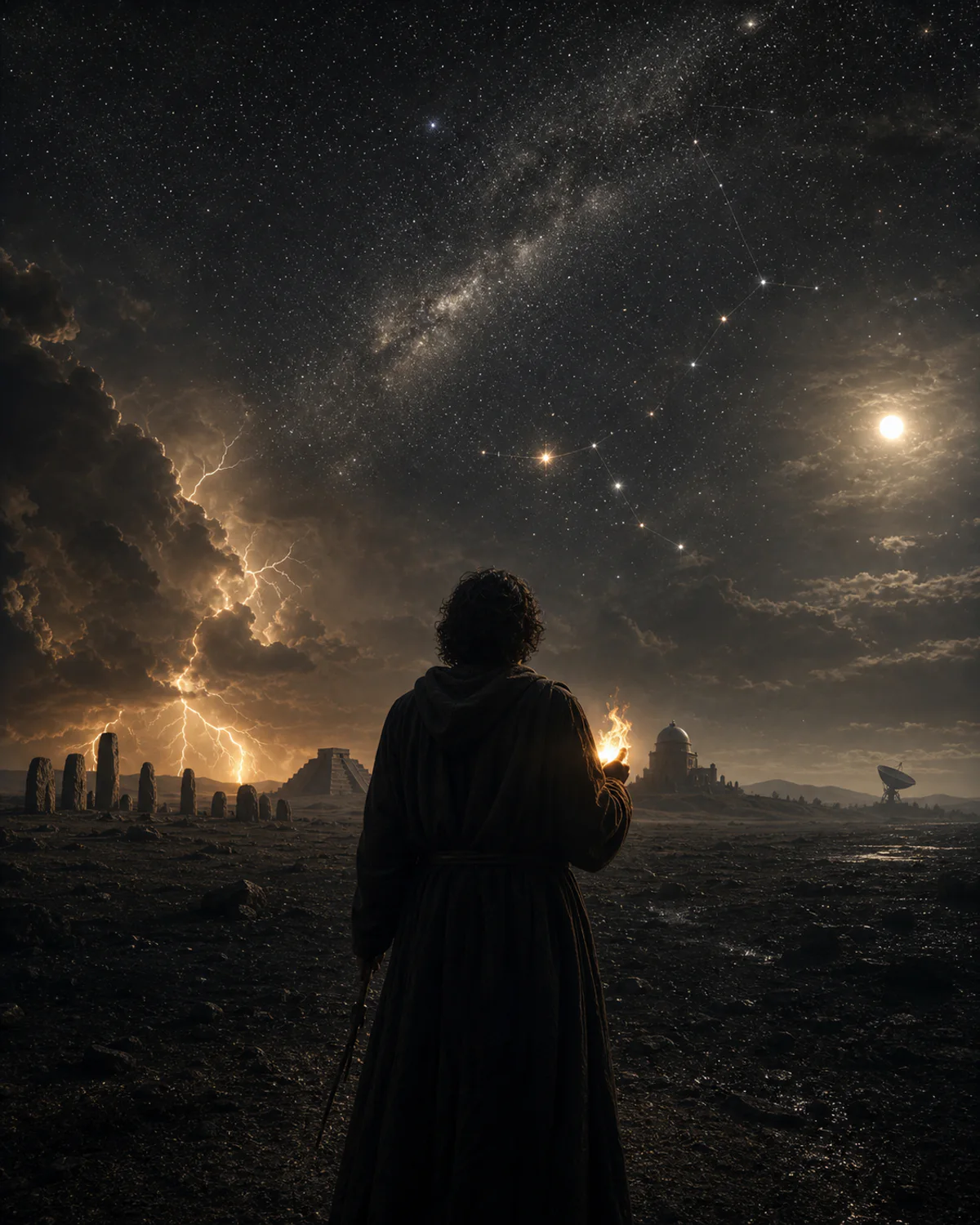
The Witnesses · VI of VI
The Question
told by the question that would not kneel
before the first altar · beyond the last laboratory
in conversation with Lucretius, Voltaire, Mary Shelley, Dostoevsky and Tagore · 18 min
IThe First Answer
I was born before writing, which means no one can tell you the date. There is no tablet bearing the first question mark, no grave in which an archaeologist has found me curled beside the dead. There are only signs of a mind becoming larger than the moment it occupied: ochre on a body that no longer breathed, beads placed where hunger could not use them, hands printed on cave walls as if a person had discovered the terror of vanishing and answered it with I was here. Perhaps I was born at a burial. Perhaps in a dream. Perhaps when lightning split a tree and one human being ran while another, equally afraid, turned back to look.
Do not let anyone tell you with confidence how religion began. The dead left symbols, not explanations of their symbols. Ritual may have bound a frightened group together; myth may have carried memory farther than any individual life; gods may have grown from dreams, ancestors, rulers, animals, storms, fertility, gratitude, terror, or all of them braided until no strand could be pulled free. The past is not stupid merely because it is past. A story that could organise grief, duty, planting, kinship and death was not an idle ornament. It was social technology before anyone had a word for technology.
But imagine the storm. The sky, peaceful all afternoon, tears itself open without warning. Fire crosses the clouds. The ground answers. Rain falls and the river rises; the same violence that can kill the hunter brings the water that keeps the child alive. You possess no electric field, no condensation nucleus, no pressure map. You possess the most powerful instrument evolution has yet given you: a mind built to detect agents. Grass moves because something moves it. A stone flies because someone throws it. A voice comes because there is a speaker. What, then, throws the lightning?
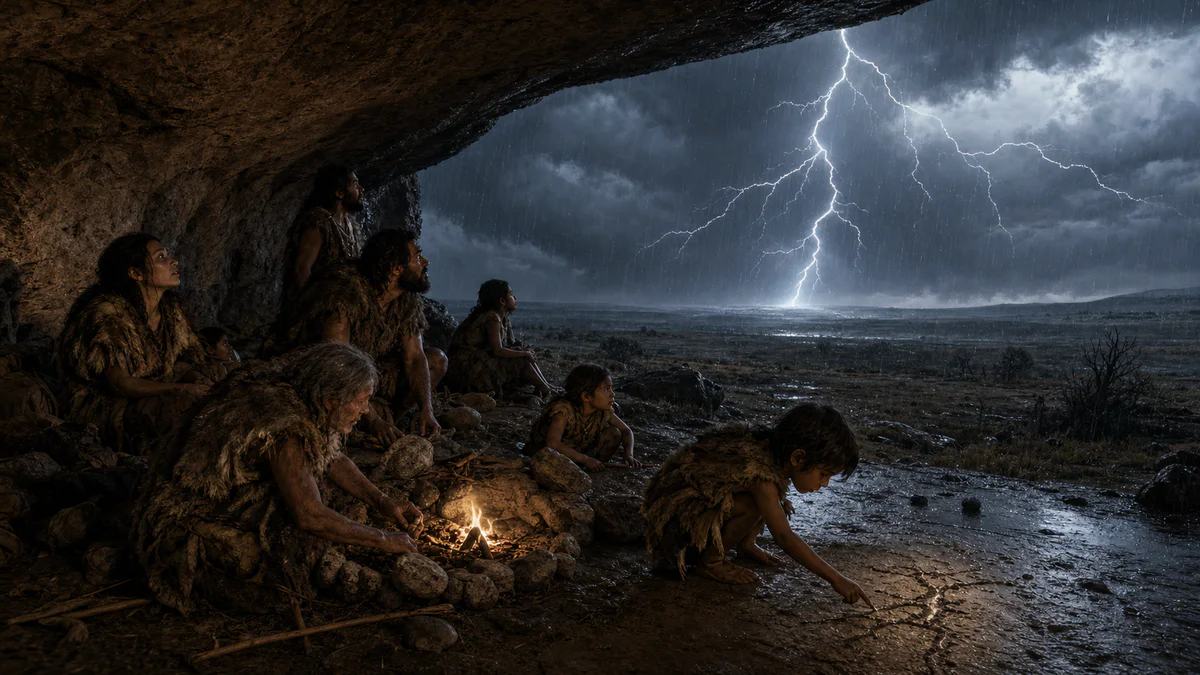
An unseen person is not a foolish answer in that world. It is an extension of the best causal model available. The storm has intention because intention is how causes are known. The Sun travels because travellers move; it sees because light reveals; it judges because nothing can hide at noon. Across civilisations that never shared a scripture, solar divinity appeared under different names and different moral worlds: Utu and Shamash in Mesopotamia, Ra in Egypt, Surya in India, Amaterasu in Japan, Inti in the Andes, Tonatiuh in central Mexico. They were not one god carelessly renamed. They were many human cultures meeting the same unbearable fact: without that light, everyone dies.
So the first answer was often a somebody. The first answer made the thunder less empty and death less final. It could also make a priest necessary, a king sacred, an enemy impure and obedience cosmic. An explanation does not remain an explanation once power discovers it. It becomes a gate, and someone appoints himself keeper. I was the small voice outside the gate. I did not yet know enough to say the answer was wrong. I asked only: how do you know?
IIWhen the Gods Learned to Count
Civilisation did not replace wonder with measurement. It made wonder keep records. Once people planted grain and remained beside it, the sky became an instrument of survival. Flood, monsoon, migration, solstice, the lengthening day: these were not abstractions but schedules on which bodies depended. The priest who announced the festival and the observer who marked the shadow could be the same person. The altar, the calendar and the tax register grew close enough to share a wall.
Night after night, generation after generation, anonymous watchers accumulated regularity. Venus returned. The Moon repeated its phases. The wandering stars did not wander without limit. Eclipses, terrifying as they were, belonged to cycles. In Mesopotamia, observations pressed into clay became series long enough to reveal patterns no single life could see. In Egypt, the rising of Sirius was bound to the Nile's season. In India, calendrical astronomy served ritual time and developed mathematical power of its own. In China, court astronomers recorded comets, novae and eclipses because heaven and government were thought to correspond. Bad cosmology could still produce excellent data.
This is the first great irony in our story: religion did not merely stand in the path of science. In many places it paid the watcher, protected the archive, required the calendar and made the heavens worth decades of attention. The motive might be divination, worship, navigation, administration or prestige. Nature did not care why it was measured. A correct shadow falls for a superstitious observer exactly as it falls for a sceptical one.
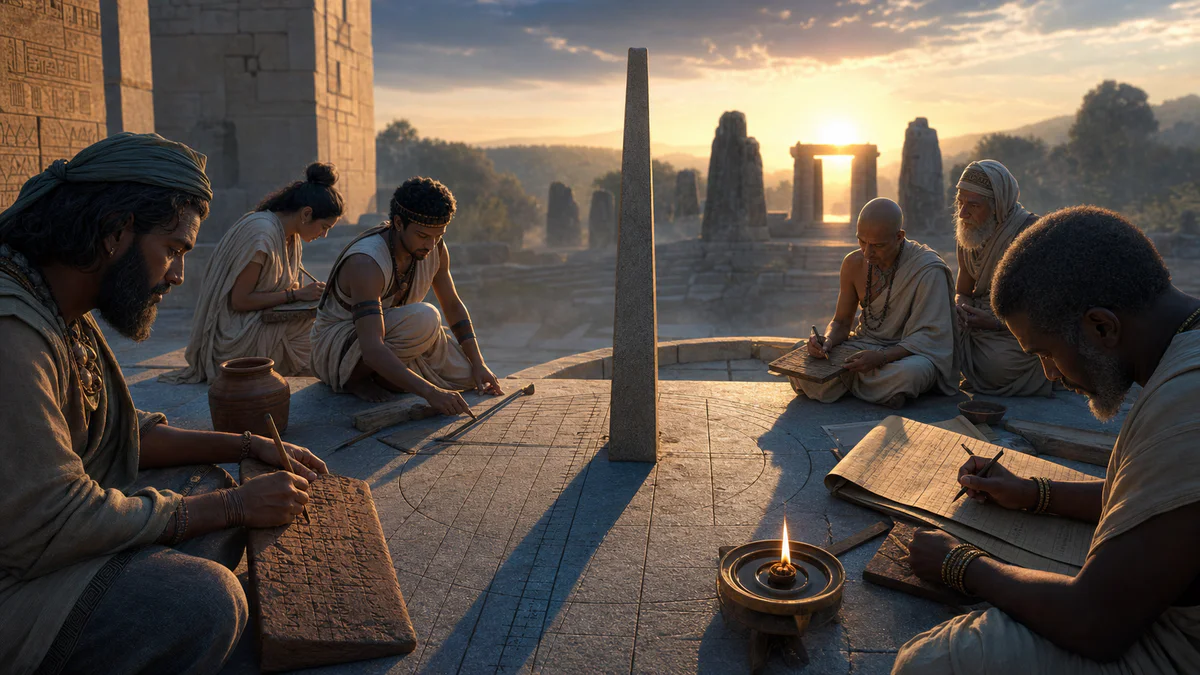
And measurement changed the measurer. Once the solstice had a position on stone, the Sun's return no longer depended entirely on a priest's mood. Once an eclipse belonged to a cycle, panic acquired a rival. Pattern is quietly democratic in this way: it can be checked. Authority says trust me. A measurement says stand here tomorrow and look.
Do not romanticise the transition. Astronomy and astrology remained entangled for centuries; accurate calendars could strengthen empires as easily as enlighten citizens. Knowledge has always been useful to power. But a line had been crossed. The divine story still explained why the sky mattered. The table began to explain what the sky would do. I lived in the distance between them.
IIIThe World Beneath the Story
Then some people committed the oldest act of intellectual disobedience: they looked for a cause that did not have a face. In the Greek-speaking cities, thinkers proposed that the world might arise from water, air, number, atoms, necessity or change itself. Their answers were often wrong. That is not an insult. To be wrong in a way that invites an argument is one of the founding achievements of civilisation. A myth can absorb contradiction and remain sacred. A proposed natural cause can be broken in public.
There was no single Greek miracle, and Europe does not own me. In classical India, traditions argued over what counted as knowledge with a precision that makes the phrase blind faith collapse from embarrassment. Nyaya philosophers examined perception, inference, comparison and testimony. Vaisheshika thinkers reasoned toward indivisible atoms; Samkhya described a dynamic nature; Buddhist and Jain philosophers built intricate accounts of causation and mind; Charvaka materialists challenged scripture, afterlife and invisible worlds. These schools disagreed fiercely because India was not one thought wearing many robes.
Elsewhere, Chinese natural philosophers investigated change through systems of correspondence, observation and practical statecraft; physicians across regions accumulated anatomy, drugs and diagnoses through traditions that mixed empirical success with metaphysical error. Knowledge did not march in a straight line from superstition to laboratory. It branched, translated, forgot, rediscovered and sometimes carried a true remedy inside a false theory.
What mattered was not that the divine disappeared. It did not. What mattered was that nature began to acquire an interior life of its own: processes, elements, regularities, causes that could be discussed without requiring a fresh intention for every event. Thunder could belong to the structure of weather even if a god had made the weather possible. Disease could have a bodily course even if suffering retained a spiritual meaning. The natural explanation did not always murder the sacred one. Often it moved underneath it and took responsibility for prediction.
I grew stronger wherever argument did not end in rank. Not because every question produced truth, but because every answer had to survive another mind. The earliest science was not a collection of correct facts. It was the dangerous cultural discovery that an answer may owe the listener evidence.
IVThe Houses That Kept the Night
Knowledge needs rooms. It needs food for the student, quiet for the translator, a roof over paper, a patron willing to finance an instrument whose result may not arrive during his reign. For long stretches of history, religious institutions supplied those rooms. To erase this because later institutions censored ideas would not defend science; it would falsify the history science asks us to respect.
At Nalanda, a Buddhist monastic and scholastic complex in India sustained organised learning across centuries. Debate was not an extracurricular activity but part of the method by which claims were tested. Across the Islamic world, scholars working in Arabic translated and criticised Greek, Persian and Indian texts. The community was never religiously or ethnically simple: Muslims, Christians, Jews, Sabians and others moved knowledge across languages because no civilisation had inherited enough on its own.
Al-Khwarizmi helped give algebra its name. Ibn al-Haytham built an account of vision around light entering the eye and insisted on geometrical reasoning tested against observation. Al-Biruni compared traditions, measured, calculated and wrote about India with an attention rare in any century. Astronomers from North Africa to Central Asia revised tables, improved instruments and constructed planetary models that later travelled into Europe. They were not modern secular scientists hiding inside a religious age. They were people of their age, and that age contained reason.
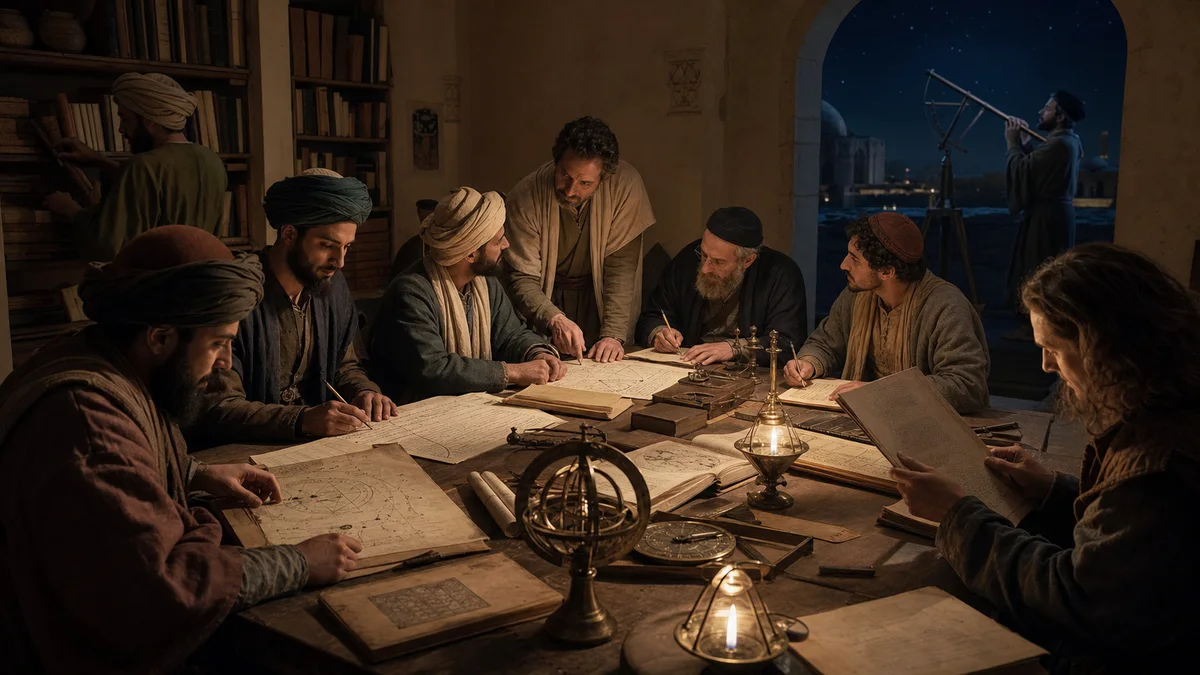
Christian monasteries copied texts; cathedral schools and medieval universities gave natural philosophy an institutional life. Clergy studied the calendar, medicine, optics and motion. This patronage was never pure. Education could guard orthodoxy and enforce hierarchy at the same time that it trained minds capable of overturning inherited ideas. Institutions are contradictory because people are contradictory. A library can contain a forbidden book. A doctrine can fund the lens that wounds it.
What moved civilisation forward was not one faith's unique generosity or another's unique hostility. It was contact: Sanskrit tables translated into Arabic, Greek astronomy criticised in Persian and Arabic, those critiques entering Latin, instruments and numbers crossing markets, monasteries, courts and ports. Every culture received a sky already studied by strangers. Purity would have left us ignorant.
VWhen Certainty Acquired a Police
The conflict became lethal when an answer no longer needed to persuade because it could punish. This happened under temples, churches, courts, caliphates, empires, parties and states. Religion has no monopoly on persecution. It has, however, often provided power with its most absolute vocabulary: eternal truth, sacred order, impurity, blasphemy, a crime not merely against a ruler but against reality itself.
Hypatia was murdered in Alexandria in 415 by a Christian mob amid a savage political and sectarian struggle. Calling her death simply science versus religion makes the city easier than it was: she was a mathematician and philosopher, but she was also a political symbol in a contest between episcopal and civic power. The complexity does not absolve the killers. It makes the lesson sharper. A crowd did not refute her mathematics. It transformed a woman who advised the wrong man into an obstacle that holiness permitted them to destroy.
Giordano Bruno was burned in Rome in 1600 after a long heresy trial. He imagined innumerable worlds and an infinite universe, ideas that later readers rightly found magnificent, but he was not executed for discovering exoplanets or practising experimental science. His theological claims, scriptural interpretations and refusal to recant were central. The honest story is already terrible. It does not need the lie that every victim of a church was secretly a modern scientist.
Galileo is different, and precise enough. His telescope showed mountains on the Moon, phases of Venus and moons circling Jupiter: a sky visibly unlike the closed perfection inherited from Aristotle. In 1633 the Roman Inquisition judged him vehemently suspected of heresy for defending Earth's motion, forced his abjuration and kept him under house arrest. Politics, personality and the scientific arguments of the day complicate the affair. They do not erase the central obscenity: an institution claimed authority over what an observation was allowed to mean.
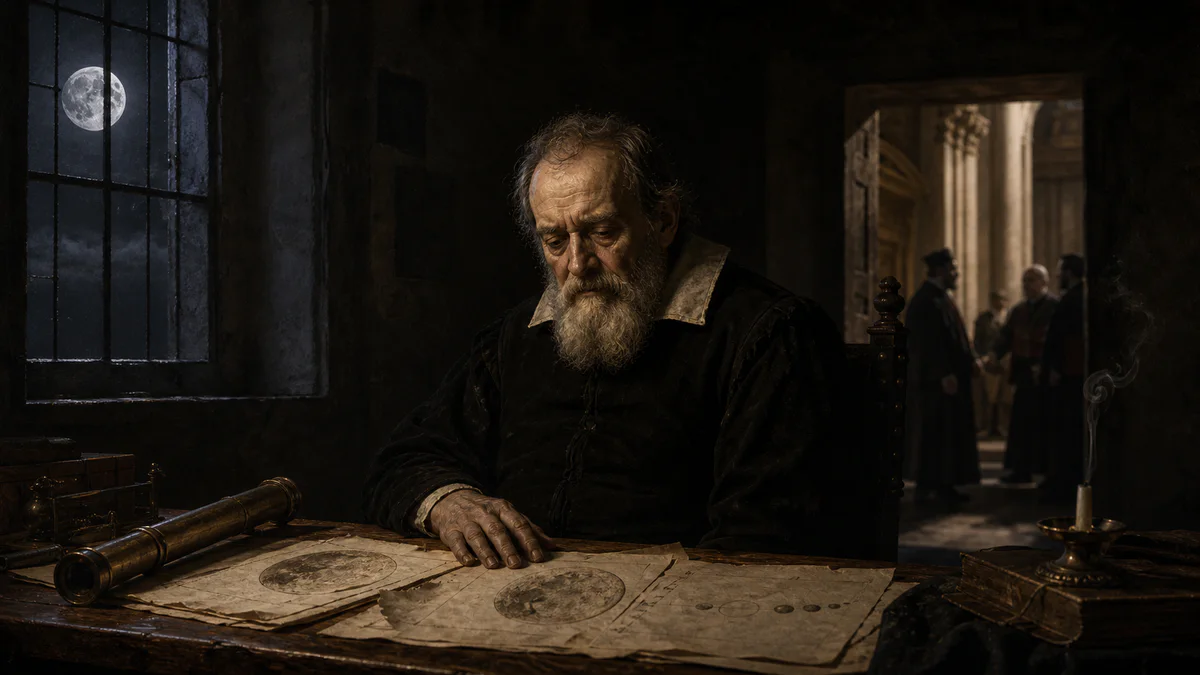
Remember the mechanism. Power rarely says, I fear the fact. It says the fact is premature, socially dangerous, morally corrupting, foreign, impious, insufficiently respectful, badly timed. It attacks the speaker's character, funding, caste, sex, loyalty or soul. It buries the question beneath procedure and calls the burial order. The vocabulary changes. The appetite does not.
VIThe Method That Distrusted Its Maker
Science became powerful not when scientists became wiser than everyone else, but when they built a method that assumed scientists could fool themselves. Measure twice. Describe the apparatus. Let a rival repeat it. Keep the failed trial. Change the claim when the world refuses it. No scripture had ever demanded this particular humiliation from its interpreters: that the text of nature could publicly force the reader to retract.
The people who developed that method did not march out of religion in a clean secular column. Copernicus was a cathedral canon. Kepler's theology helped drive his search for mathematical harmony even as the planets broke his preferred perfect circles. Newton wrote more on theology and biblical chronology than most admirers of his physics like to remember. Pascal made probability and religious wager inhabit the same severe mind. Their faith did not certify their equations, and their equations did not erase their faith.
This coexistence is not proof that a religion is true. It proves something more limited and historically important: scientific practice does not require atheism. It requires methodological restraint. In the laboratory, an invisible will that can produce any possible result predicts nothing. The scientist may believe in God before entering and after leaving. During the experiment, the pipette must still be calibrated.
That boundary is one of humanity's finest inventions. It does not declare that only matter exists; that stronger philosophical claim is naturalism and must make its own argument. The boundary says that a scientific explanation must risk contact with evidence. A cause compatible with every observation is not an explanation science can test. This is why lightning ceased to require Zeus without physics having to search Olympus and report an empty chair.
Religion changed under this pressure. Many believers learned to read creation stories as theology, poetry or moral cosmology rather than geology. Some resisted. Some still resist. But a faith capable of metaphor can survive a telescope; a faith that stakes itself to a false measurement eventually asks its followers to choose between honesty and belonging.
VIIThe Animal Without a Pedestal
Geology made the Earth old before biology made humanity ordinary. Layer by layer, fossil by fossil, the planet outgrew the chronologies imposed on it. Then Darwin and Wallace gave the diversity of life a mechanism without foresight: variation, inheritance, differential survival, time. No hand needed to sculpt each species separately. The eye itself, so often offered as proof of design, could be approached through cumulative change.
The shock was not simply that humans had animal ancestors. Every anatomy lesson already placed us among mammals. The deeper wound was that adaptation could arise without anticipating us. Natural selection has no picture of the future and no moral preference for intelligence. It keeps what reproduces in a particular environment. The tree of life does not place Homo sapiens at its top because a tree has no top.
Religious responses were divided from the beginning. Some attacked evolution because it collided with literal creation and human exceptionalism. Others accepted it, revised theology around it or saw natural law as the manner rather than the rival of creation. Darwin himself moved through belief, doubt and agnosticism for reasons both intellectual and personal. The famous war was never two armies in uniform.
At nearly the same time, Gregor Mendel, an Augustinian friar, counted traits in pea plants and uncovered regularities of inheritance that later joined evolutionary theory. He is not a convenient mascot proving that church and science are always friends. He is a human fact that ruins the opposite simplification. The cassock and the data occupied one garden.
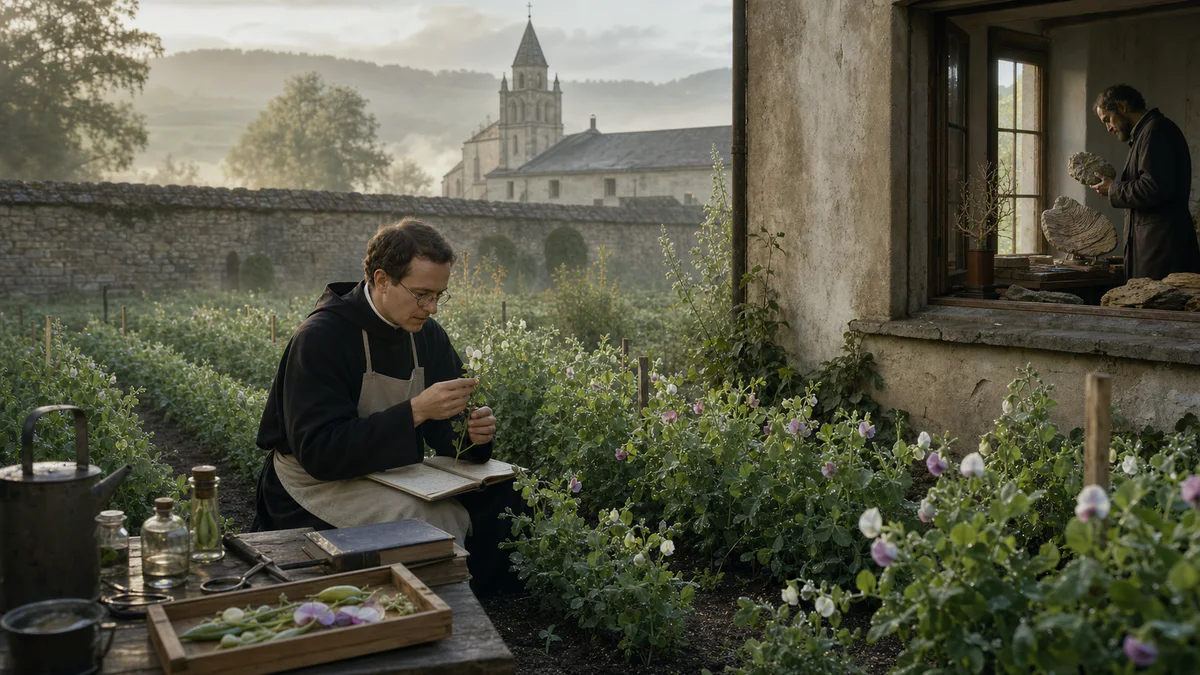
Evolution does not scientifically disprove God. It does destroy the need for special creation as a scientific account of biological diversity, because common descent and natural selection explain the evidence and continue to survive tests. A believer may place purpose behind that history; a naturalist may see no purpose at all. Neither may rewrite the fossil, the genome or the age of the Earth to make the universe flatter his desire.
VIIINo Innocent Instrument
Now I must turn the blade. It is easy for science to recount the crimes of religion because the instruments of science preserve evidence. It is harder for science to examine the blood on its own instruments. Knowledge does not make its possessor good. It makes the possessor capable.
Modern science lengthened life, reduced infant death, made clean water engineerable, revealed pathogens, electrified cities, crossed oceans and worlds, read the genome and let strangers speak across the planet. No civilisation can feed, heal, transport or educate billions through revelation alone. The material structure of modern life was built by observation, mathematics, experiment, engineering and the labour of people whose names institutions often forgot. On this point sentimentality is dangerous: when a child needs insulin, metaphor is not medicine.
But measurement also served conquest. Anthropology ranked people into invented hierarchies. Eugenics dressed prejudice in statistics and called coercion improvement. Physicians experimented on people denied consent. Chemistry made fertiliser and gas; physics opened the atom and then a city vanished in light. Computer science can distribute knowledge or surveillance with equal indifference. A result tells us what can be done. It does not tell us whether doing it is just.
Religion cannot claim the moral high ground without confession. Sacred language has blessed conquest, caste, slavery, forced conversion, misogyny and massacre. It has also sustained abolitionists, hospitals, mutual aid, sanctuary, nonviolence and resistance. The same tradition can be quoted by the jailer and the prisoner because traditions are arguments carried through time, not single moral machines.
Civilisation is therefore not saved by replacing priests with technicians. A laboratory coat can become vestment; a model can become oracle; expertise can hide unexamined values behind numbers. The answer is not less science. It is science made answerable to ethics, democracy, history and the people on whom its power acts. Evidence without conscience is efficient barbarism. Conscience without evidence is helpless intention.
IXThe Superstition That Learned to Stream
You may think this struggle belongs to old temples and candlelit courts. Look at the device in your hand. Astrology travels at the speed of fibre. Miracle cures are sold beside targeted advertisements. A rumour can cross a nation before a laboratory finishes one careful test. Ancient superstition has acquired analytics, video, payment infrastructure and an algorithm trained to discover which fear keeps you watching.
Religious certainty still kills when prayer is substituted for treatment, when disease is called punishment, when textbooks are forced to flatter scripture, when a woman is denied autonomy because authority has declared her body property, when a child is taught that asking is betrayal. Cultural reverence does not excuse empirical falsehood. A tradition may deserve understanding; a claim about vaccines, eclipses, evolution or climate still deserves a test.
Science has its counterfeit faith too. People say the data speaks, as though data had a mouth independent of who collected it. They call an algorithm objective while hiding its training set. They confuse technological novelty with progress and intelligence with wisdom. They assume that what cannot yet be quantified does not matter, then discover too late that dignity, consent and grief were part of the system.
The most dangerous superstition of the modern age may be certainty wearing the costume of its enemy. Pseudoscience borrows graphs. Nationalism borrows archaeology. Markets borrow evolution. Authoritarian states borrow public health. Artificial intelligence borrows the voice of knowledge and can produce an error with perfect grammar. The surface of reason is easy to imitate. Its discipline is not.
Ask the old questions in their modern form. What evidence would change your mind? Who benefits if you believe this? Can an independent person reproduce the result? Are uncertainty and failure visible, or has the institution edited them out? Does the claim become angrier when examined? A truth does not become false because a wicked person says it. A lie does not become true because your community needs it.
XWhat the Sky Does Not Owe Us
I have lived long enough to watch gods become metaphors and metaphors become weapons and weapons become museum pieces beneath electric light. I have watched science inherit the authority it once opposed and begin, at its worst moments, to speak as though every human question were a technical inconvenience awaiting funding. I distrust every throne built for an answer.
Science and religion do not grow together like two trees planted in harmony. They grow through one another like roots in an old city: feeding, obstructing, cracking foundations, holding soil, impossible to separate without inventing a cleaner past than anyone lived. Sometimes faith protected inquiry. Sometimes it ordered inquiry to kneel. Sometimes science liberated a mind. Sometimes it gave an empire a more precise chain.
There is a boundary worth defending. When a claim concerns the shared natural world, evidence must outrank revelation. A virus does not respect sincerity. A planet does not alter its orbit for a majority vote. A species does not abandon its ancestry because the fact wounds a sacred story. Public policy, medicine and education cannot be governed by an unseen authority that no citizen is permitted to test.
Beyond that boundary remain questions science may illuminate but cannot settle by measurement alone: what suffering asks of us, why a life should be lived justly, what beauty does inside a finite mind, how grief becomes bearable, whether existence has an ultimate purpose. Religion has no automatic ownership of these questions, and science has no warrant to call them meaningless. Philosophy, art, community and private faith enter here, not as rival laboratories but as human attempts to live with what knowledge cannot choose for us.
A mature religion need not fear a mechanism. If there is a God worthy of the name, that God does not require a false age for the Earth, a fabricated fossil, a silenced astronomer or a sick child denied medicine. A mature science need not sneer at awe. To understand the fusion in a star is not to exhaust what a person feels beneath it. Explanation can deepen wonder when wonder no longer demands ignorance as its price.
So I do not ask humanity to abolish belief. I ask belief to surrender its weapons. I do not ask science to apologise for dissolving a superstition. I ask science to remember that power is not wisdom. Keep the temple if it shelters grief. Keep the poem if it enlarges mercy. Keep the ritual if no one is forced to perform it. But when the thunder comes, teach the child the charge in the cloud.
That child is where I live now. She looks through a telescope built from centuries of argument. Beside her stands a believer, an atheist, a person who has not decided, and someone whose language for the sacred has no English equivalent. None owns the instrument. None owns the sky. The photon enters without checking doctrine.
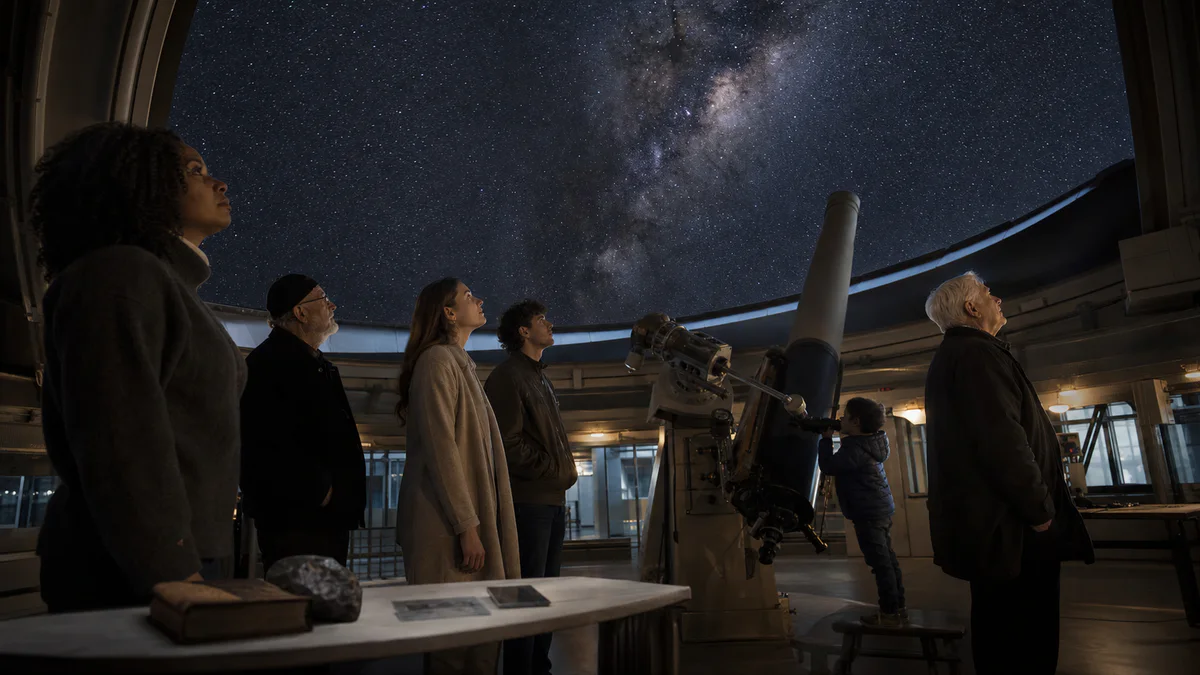
Civilisation advances when the question is protected from the answer. It advances because men and women refuse the comfort of inherited error, because someone records the anomaly, repeats the trial, translates the stranger, treats the outcast, looks again. They are not always saints. They are not always brave. But in the decisive moment they prefer the world as it is to the world they were ordered to see.
I was there before the first altar. I will remain after the last laboratory has become dust. Every answer you build is temporary housing, and I am the weather. Do not worship me; questions can be cruel, trivial and vain. Do not silence me either. Give me evidence. Give me argument. Give me the freedom to return. Then look up together, into the ancient dark that made both the god and the telescope, and ask once more.
Sources and historical notes
The novel is literary; the history is documented. These works anchor its chronology and its claims.
- Smithsonian Human Origins ProgramBurial and the archaeological evidence of symbolic behaviourNational Museum of Natural History
- The British MuseumSolstice, sunshine and the sacredCuratorial essays on solar traditions across cultures, 2024
- Stanford Encyclopedia of PhilosophyNaturalism in Classical Indian PhilosophyRevised scholarly reference
- UNESCO World Heritage CentreArchaeological Site of Nalanda MahaviharaWorld Heritage documentation
- UNESCO Astronomy and World Heritage InitiativeIslamic AstronomyHeritage Sites of Astronomy and Archaeoastronomy, 2010
- Stanford Encyclopedia of PhilosophyGalileo GalileiRevised 2025
- John Hedley Brooke and later historiansHistory of science, religion and the complexity principleBJHS Themes, Cambridge University Press, 2024
- National Academy of SciencesScience, Evolution, and CreationismNational Academies guidance on evidence and supernatural claims