The Witnesses · I of VI
The Oldest Light
told by a quantum of the first light
380,000 years after the beginning
after Italo Calvino and Jorge Luis Borges · 6 min
IThe Crowd
I was born in a crowd so dense that being born meant nothing. You must understand this first: in the beginning, light was not something that travelled. Light was something that was passed around. I would leap from an electron and before I had gone the width of a breath another electron would seize me, hold me an instant, and fling me elsewhere. All of us lived this way — a hundred billion of us for every particle of matter, an ocean of light scattering in a fog of its own brilliance — and none of us had ever seen anything, because seeing requires distance, and there was no distance. There was only the next collision.
It was not unpleasant. I want to be fair to that time, since no one else remains who can be. The whole universe was one glowing thing at one glowing temperature, and if you had asked any of us — had asking been possible in that roar — we would have said it will always be like this. This is what everything is. A fog of fire, everywhere, forever.
But the fog was thinning. The universe was stretching, and as it stretched it cooled, the way a crowd disperses as the hall grows larger, the way a shout loses heat across a widening field. We did not know we were waiting. There was no word for waiting. There was no word for anything; words were three hundred and eighty thousand years away, and then some.
IIThe Letting Go
The moment itself was ordinary, which is the thing I have never gotten over. There was no signal, no shudder, no announcement. The universe simply cooled past a threshold — a few thousand degrees, the temperature of a candle flame's modest cousin — and suddenly the electrons, which had spent all of history free and greedy, fell into the arms of the protons and were married, and made the first atoms, and went quiet.
And the fog was gone. Between one scattering and the next scattering there was no next scattering. I flew, and nothing stopped me. I flew, and nothing stopped me. You cannot imagine what that was like, and I say this without condescension: you literally cannot, because your whole existence happens inside space that is already transparent, and you have never once been let go of after an eternity of being held.
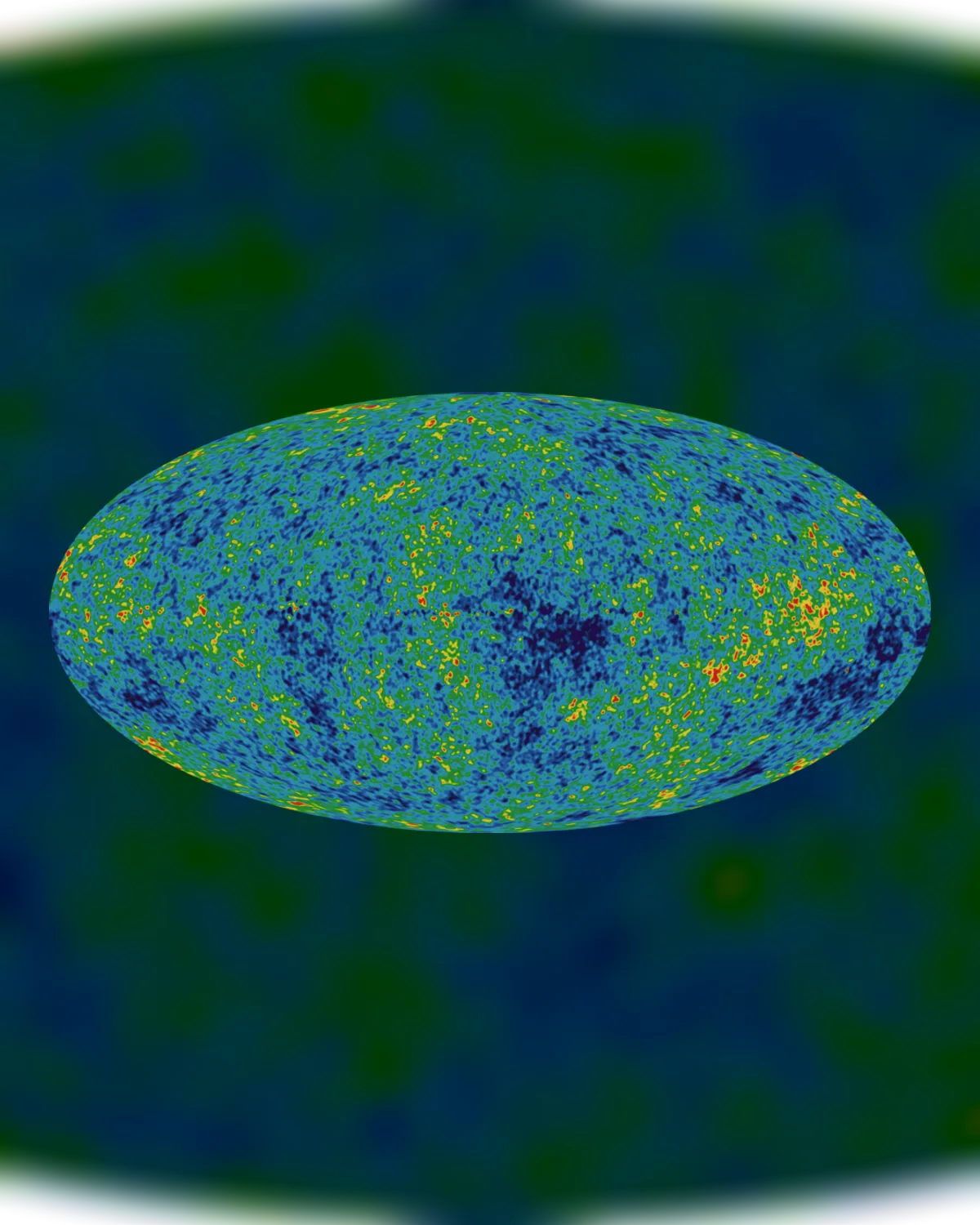
Every photon in the universe was released in that same long moment. All of us, everywhere, set out at once — the greatest departure there will ever be, and the quietest. The universe turned from fog to glass, and we poured through it in every direction, carrying on our backs the only photograph of the world before: a map of how the crowd had stood, its little crowdings and thinnings, at the instant it let us go.
I did not know I was carrying it. The mail does not read the letter.
IIIThe Long Falling
What does one do for thirteen and a half billion years? One falls. Not downward — there is no down between the galaxies — but forward, always forward, at the one speed I am permitted, which is the fastest speed there is and feels, I must tell you, like no speed at all. For me, no time passes. This is not a poetic flourish; it is the strict accounting of relativity. From the inside of my flight, the letting-go and this sentence are the same instant. It is everyone else who has been living through the thirteen billion years, growing old in the corridors of my one moment.
But I saw it — in the way a passenger sees a country through the window of a night train. The darkness came first: once we ancient photons had reddened out of visibility there was nothing to shine, and the universe went black for a hundred million years, a blackness with grains of promise in it. Then the grains caught. The first stars lit — brutal, blue, enormous — and where there had been my one departing generation of light there were now new photons, young and hot and local, who knew nothing of the crowd and the fog. Galaxies gathered like lamplit towns seen from a distance. They spiralled, collided, merged, settled. I flew past them all. I never stopped once.
The stretching that had freed me kept working on me as I flew. Every year of my journey, space itself widened beneath my wavelength and pulled it longer — from orange light to red, from red to infrared warmth, from warmth to the long cold syllables of microwave. My voice, which began as the roar of a furnace, is now a murmur three degrees above absolute silence. This is what the universe does to its first witnesses. It does not silence them. It deepens them until only careful listeners can hear.
IVThe Horn
In the last second of my flight — and remember, for me it was all one second — a spiral town of four hundred billion lamps rose ahead, and in it a small yellow lamp, and around that lamp some dust that had organised itself into oceans and grammar. On a hill in a place its organisers called New Jersey stood a horn of aluminium, twenty feet long, shaped like an ear turned to the sky, and I will not pretend I chose it, because choosing is not a thing I do. But I ended there, in the spring of what they counted as 1964, in the cold throat of the Holmdel horn antenna.
Two men had been trying all year to make their instrument perfectly quiet. They had chased out every hum and hiss they could name; they had evicted a pair of pigeons who were nesting in the horn and scrubbed away what the pigeons had left; and still there remained a faint, stubborn static that came from every direction of the sky equally, day and night, season after season. They checked the wiring. They checked the pigeons again. The hiss would not leave, because the hiss was us — the entire first generation of light, arriving from everywhere at once, as we have been doing without pause since before the Earth existed.
So my thirteen-billion-year flight ended as a small electrical flutter in a cooled receiver, and then as a number in a notebook, and then as a telephone call to some theorists down the road at Princeton who had predicted us and not yet gone looking. I became, in my last instant, the confirmation of the Big Bang. Not bad, for static.
VWhat We Were
You have seen my family, by the way. In the age of the old televisions, when a set lost its channel and filled with dancing snow, about one flake in every hundred was one of us — a photon of the first light, ending its journey in your living room, mistaken for nothing. Whole evenings of the creation, dismissed with a slap on the cabinet.
I do not resent it. This is the part I would have you keep. The universe let go of everything it had, all at once, into the dark — and thirteen billion years later, some of the dust it let go of had become beings who built an aluminium ear on a hill because they wanted to know if anyone had ever sent a message. And the message was there. It had been arriving the whole time, from every direction, older than the stars, softer than a breath: the universe's only baby picture, still falling on every open hand.
They gave the two listeners a Nobel Prize. They gave the pigeons no credit at all. And they still keep maps of us — of the little crowdings and thinnings I carried on my back — pinned up in their observatories, and they read in those maps the seeds of every galaxy, including the one that grew the hill, the horn, the men, and you: the ones we were falling toward all along.