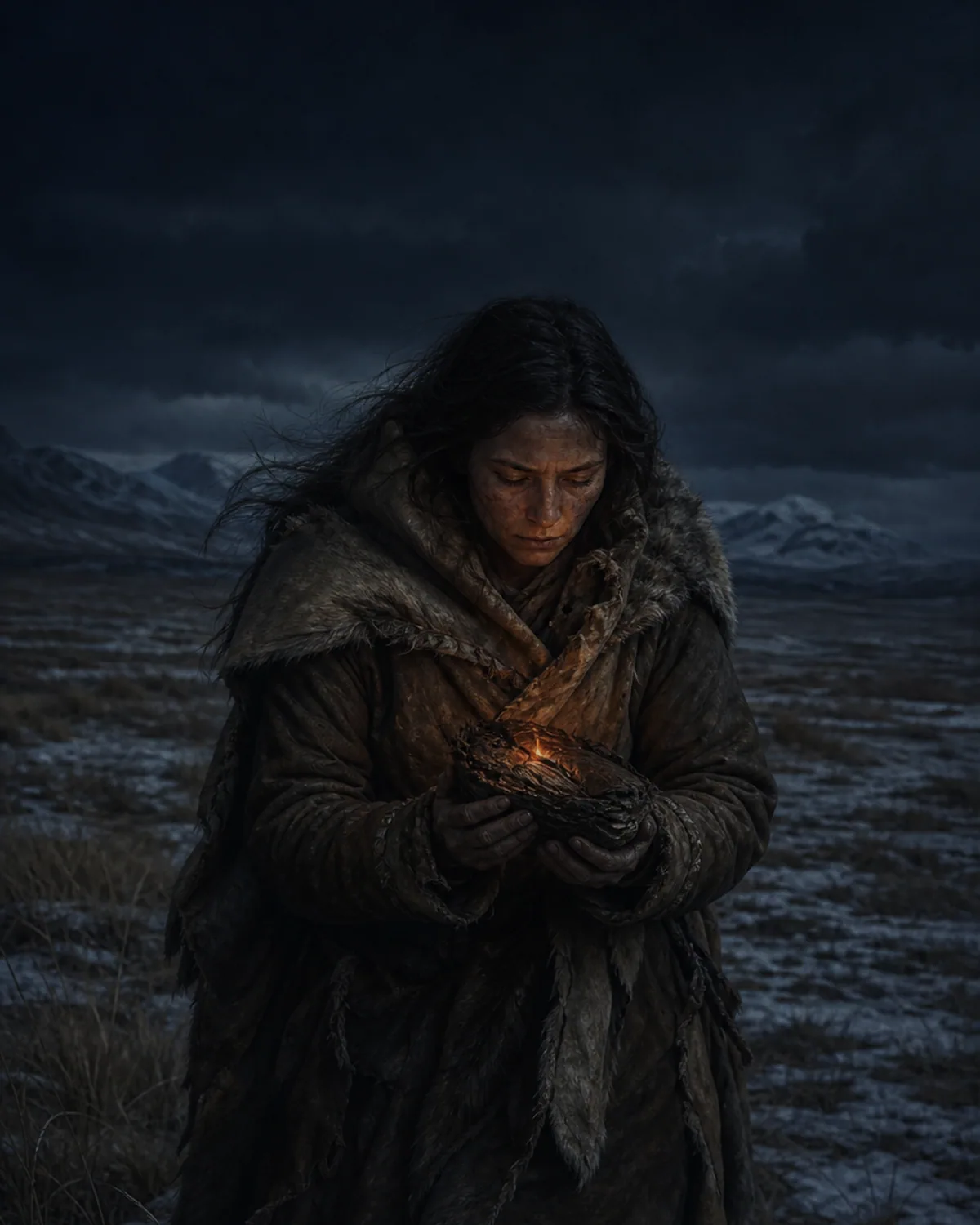
The Witnesses · IV of VI
The Keeper of Fire
told by a woman of the ice-age steppe
forty thousand years ago
after Cormac McCarthy and Toni Morrison · 7 min
IThe Flood
The river came into the camp in the dark and took what it took. It took the south windbreak and two spears and the good hides and it took the fire. In the grey morning we stood in the mud where the fire had been and the firepit was a black mouth full of water and no one spoke. The old man put his hand in the wet ash to the wrist and held it there and then took it out and we knew.
You who have never lost fire cannot know what we lost. Fire was not a tool among our tools. Fire was the border of the world. Inside the light was us and outside the light was everything that wanted us, and the border moved as the fire breathed, and we lived our whole lives inside that breathing. We did not know the making of it. I will say that now without shame because shame is for the warm. Some bands knew the making, the strike and the spark, and we did not. We kept it. We had kept it since my mother's mother's time, fed and banked and carried, a thing alive, an ancestor that ate. And in one night of black water it was gone.
There was another fire in the world. Three days north, at the winter camp under the painted overhang, banked in its pit and waiting under a roof of stone. Three days for strong legs in good weather. It was not good weather. The old man looked at the six of us left standing and then he looked at me. My daughter still slept against my back where I had carried her out of the water. He did not say why me. Maybe because I had the child and the child had no one else. A woman carrying a life will not lie down in the snow. They raked the drowned pit a last time and found in the deep of it one coal with a red seed in its heart, and they set it in a horn packed with dry moss and punk, and they put the horn in my two hands.
IIThe Carrying
A coal is a small god and like all gods it lives by dying. Too little air and it goes to black stone. Too much and it eats its bed and starves in an hour. All that first day I walked north with the horn inside my coat against my skin and I felt its little heat like a second heart and I fed it air by turnings, a breath through the horn's mouth at the crest of every rise. Snow to the knee. The child quiet on my back, watching the world over my shoulder, and behind us at a distance a dog. Not a wolf and not yet a dog. One of the grey ones that had taken that winter to standing at the edge of firelight with its ears up. It followed all day at forty paces and I let it.
The second day the wind came down the steppe like something with intent and I made a den of snow and willow in the lee of a stone and lay curled around the horn with the child curled around me and the not-yet-dog, that second night, lay against my back. I did not drive it off. Heat is heat. I fed the coal moss shaved thin as a leaf's skin and I sang to it, low, the song my mother sang to fires, because a thing that is sung to is a thing someone refuses to let die. The child slept. The wind read the land all night like a blind man reading a face.
I will tell what I thought in the dark since there is no one left it can shame. I thought: this is what we are now. Not the strongest thing on the plain and not the fastest and not the warmest. The mammoth wears its fire as wool and the lion carries its knives in its mouth. We alone have our fire outside our bodies, in a horn, in a stranger's hands, and so we alone can lose it, and so we alone must carry it, and the carrying is the whole of us. Everything after — I know this now, I have had ten thousand nights to know it — everything after is carrying. The seed in the pouch. The name in the mouth. The child on the back. We are the animal that keeps its heart outside itself and walks it through the snow.
IIIThe Grave
On the third morning we passed the place where the boy was buried in the autumn, the old man's grandson, under the leaning stone. We had laid him in with red ochre dusted on him like a sunrise and a fox-tooth string at his throat and his little spear beside him though it had never killed more than a hare. I stopped there with the horn against my heart. I do not know what the burying is for. No band remembers who began it or what it buys. I know only that we cannot put our people in the ground bare, as the deer falls, as the fish washes up. Something in us has begun to say after. Something in us has started keeping the dead, the way we keep fire, a warmth carried on from a life gone out.
I stood at the stone and I said his name. That is another carrying. A name is an ember too. Say it and the dead flare up red for a breath in the middle of your chest. I said his name and the child on my back said it after me, small and wrong and holy, and the sound of it in her new mouth was the sound of the thing continuing. Then I walked on because the coal was lighter than the morning before and a lighter coal is a dying one.
The last hours were bad and I will not dress them. The horn cooled. I ran where the crust held me. I fell once through river ice to the thigh and did not stop to be afraid. I came up the moraine at dusk with my legs gone to wood and the overhang firelit above me — they had kept it, of course they had kept it, the coal I carried was the promise not the need — and I could not climb, and I called, and they came down to us with torches. And that night our seed of the old drowned fire was set into the great fire of the winter camp, flame folded into flame like water into water, and the border of the world stood up around us breathing, and inside it I ate fat meat with my daughter in my lap and the dog — I may as well now say the dog — lay at the fire's edge, inside the light. First of all its kind to sleep there. It had carried nothing but its hunger. But the fire took it in too. The fire was always going to be for more than us.
IVThe Door
I am old now and I sit at fires I did not carry and the young ones bring me the soft parts of the meat. My daughter has daughters. One of them, the quick one, learned the strike and the spark from a man of the reindeer people, and so my grandchildren cannot lose fire — they can only make it — and they listen to the story of the horn and the snow the way you would listen to a tale of swimming before boats. Kindly. Not believing the fear.
But I have seen the door their safety opens. In the warm valleys south, they say, there are bands who no longer follow the herds at all. They stay by their rivers all year and they put seeds into the ground on purpose and wait beside them, and the seeds come up as a field, and the field is a fire that does not walk. I did not believe it either. But my quick granddaughter believes it, and her children will see it, and I know already, the way I knew the wind that night was going to try us — I know what walks through that door. Stay for the field and you build the house. Build the house and you fill the store-pit, and a full store-pit needs a mark for whose it is, and a mark that means a thing is very near to a mark that says one. Count and be counted. Villages. Debts. Names cut in clay outliving the mouths that made them. Kings, and the graves of kings, stocked like winter caches for a journey we still cannot see the end of. All of it is carrying. All of it is the horn in new hands.
Some nights by the fire I hold what is left of that ember — a black stone now, kept in a pouch, kept because I am foolish and old — and I look up at the sky's white river of stars, and I think: whoever we become, however far the fields and the marks and the kings take us from the snow, we will still be the creature that walks its heart through the dark to keep the light alive for people it may never reach. And someday — laugh, girl, but hear me — someday one of my line will stand under this same white river and choose the coldest, farthest dark of all to carry a fire into. I have carried fire. I know the look of the ones who will do it. They are always the ones with a child asleep on their back.